

Höre diesen Podcast kostenlos in der App: Kostenlos im App Store laden
radio.at
Sleeptimer
Sender speichern
31 Episoden
Dr Kareem El-Badry, incoming Assistant professor at Caltech
26.05.2023 | 25 Min.Welcome to episode 30 of exploring astrophysics with me, Vikram Bhamre. Today I am joined by Dr. Kareem El-Badry, a researcher who works mostly in the analysis of binary star systems and has obtained the nickname ‘Black hole destroyer’ for some of his past work. Stay tuned to hear more about that!Dr. Lynne Hillenbrand, Professor of Astronomy at Caltech
03.05.2023 | 31 Min.Hi everyone, welcome to another episode of exploring astrophysics. Today I am speaking to Dr Lynne Hillenbrand, a professor of Astronomy at Caltech who is an expert in the formation and evolution of young stars and the formation of star clusters. Dr. Hillenbrand spoke to me about trying to learn more about the evolution of these young stars, whose processes are often hidden behind dust and gasses from the Nebula it is in. Her work is partly focus on the properties of the circumstellar disc, a disc of gas and dust that rotates around a young star.Dr Maria Charisi, Postdoctoral associate at Vanderbilt University
26.03.2023 | 21 Min.Today I am joined by Dr Maria Charisi, a postdoctoral associate at Vanderbilt university. Her expertise is in looking for Supermassive Black-Hole Binaries: which are systems that are formed during the collisions of galaxies and weigh well over hundreds of millions of times our Sun. Dr Charisi also talked about her experience in academia and how she would describe it to someone potentially looking for a career in research.Dr Robert Simcoe, Director of MIT's Kavli Institute for Astrophysics and Space Research
20.02.2023 | 23 Min.In this episode, Dr Simcoe spoke about his research involving spectroscopy to look back into the early universe and search for the first stars. He also spoke about another interest of his - designing and building astronomical telescopes and instruments - and how it first began when he was still in high school. Lastly, he gave us a sneak peek into the job of a director of a huge astrophysics department like MIT's Kavli institute and the work that goes in to managing it.Dr Gina Panopoulou, Assistant professor, Chalmers University of Technology
27.12.2022 | 16 Min.In this episode, Dr Panopoulou spoke about how every galaxy has a magnetic field, and by using the polarisation of light we are able to map the structure of this field in our galaxy. We talked about the difficulties of doing this, including the limited information the polarisation of light can convey and how hard it is to check the accuracy of any results.
Weitere Astronomie Podcasts
 The Supermassive PodcastAstronomie, Geschichte, Physik, Wissenschaft
 Der unerklärliche PodcastAstronomie, Comedy, Geschichte, Gesellschaft und Kultur, True Crime, Wissenschaft
 Schlafreise durchs UniversumAstronomie, Technologie, Wissenschaft
 Cosmic LatteAstronomie, Physik, Wissenschaft
 Das UniversumAstronomie, Gesellschaft und Kultur, Nachrichten, Wissenschaft
 AstroGeo - Geschichten aus Astronomie und GeologieAstronomie, Geowissenschaften, Naturwissenschaften, Physik, Wissenschaft
 Ready for Liftoff! Der Raumfahrt-PodcastAstronomie, Technologie, Wissenschaft
Trending Astronomie Podcasts
- Der unerklärliche PodcastAstronomie, Comedy, Geschichte, Gesellschaft und Kultur, True Crime, Wissenschaft
- The Supermassive PodcastAstronomie, Geschichte, Physik, Wissenschaft
- Das UniversumAstronomie, Gesellschaft und Kultur, Nachrichten, Wissenschaft
- Schlafreise durchs UniversumAstronomie, Technologie, Wissenschaft
Über Exploring Astrophysics
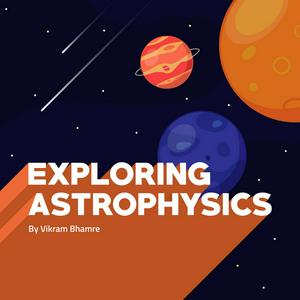
Join me as I learn about the world of Astrophysics. My name is Vikram Bhamre and I am 18 years old. On my podcast, Exploring Astrophysics, I chat with some of the most incredible astrophysicists around the world on the most interesting questions left unanswered in astrophysics. What's amazing is how helpful and forthcoming they all are and I hope you too are inspired when you listen to them.
Podcast-WebsiteHöre Exploring Astrophysics, The Supermassive Podcast und viele andere Podcasts aus aller Welt mit der radio.at-App
Hol dir die kostenlose radio.at App
- Sender und Podcasts favorisieren
- Streamen via Wifi oder Bluetooth
- Unterstützt Carplay & Android Auto
- viele weitere App Funktionen
Hol dir die kostenlose radio.at App
- Sender und Podcasts favorisieren
- Streamen via Wifi oder Bluetooth
- Unterstützt Carplay & Android Auto
- viele weitere App Funktionen
Exploring Astrophysics
Code scannen,
App laden,
loshören.
App laden,
loshören.
 Österreich