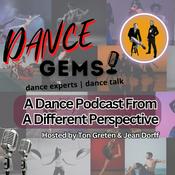
Dance-GEMS

Jean Dorff and Ton Greten
Dance-GEMS
Neueste Episode

63 Episoden

  • Dance-GEMS

    #3/6 Dance GEM's International Innovation Seminar

    31.10.2025 | 25 Min.
    In this special episode, the Dance Gems team shines a spotlight on an unmissable event: the Dance GEM International Innovation Seminar 2025, hosted in the beautiful city of Kerkrade, Netherlands, byTon Greten, creator of the GEM method, to discuss everything you need to know about the upcoming seminar, its unique format, the guest lineup, and what sets this conference apart from anything else in the dance world.
    Ton shares insights into why he brought the seminar to his own dance studio after two years in Berlin, reveals the impressive roster of international professional dancers and choreographers attending, and explains how the GEM method transcends dance disciplines. Whether you're a teacher, student, seasoned pro, or passionate amateur—this seminar promises inspiring crossovers and new ways of thinking about movement, dance education, and creativity.
    1. Cross-Disciplinary Learning & Collaboration
    This conference brings together top-level dancers and teachers from diverse backgrounds: ballroom, classical ballet, hip-hop, breakdance, contemporary, and more. You’ll experience a rare environment where diverse dance styles connect, collaborate, and exchange ideas. (You’ll witness and participate in genuine crossovers between genres—something Ton says is “very unusual” and “probably once in a lifetime.”)
    2. The GEM Method: Dance from a Different Perspective
    Ton Greten’s method—built from 15,000+ hours of research—offers tools, strategies, and language for teaching, learning, and moving that apply to all dance styles and all ages. The focus on language, proprioception, musicality, and neologisms helps dancers break out of their usual patterns and see dance through a fresh lens—no matter your experience or background.
    3. Inclusive & Supportive Community
    The seminar is open to all ages and levels, from world-class professionals to dedicated amateurs. Each participant is treated equally, fostering a true sense of community and shared inspiration. “Quality has no age,” says Ton, and learning here happens through discovery, dialogue, and stepping out of your comfort zone.
    4. International Connections & Unique Experiences
    Meet colleagues and dancers from across the globe—America, Egypt, Russia, Curacao, the Netherlands, and more. You’ll have the chance to connect, learn, and share experiences with people you’d likely never meet otherwise. Plus, you’ll experience Dutch hospitality in Kerkrade, with great local food and a beautiful dance studio setting.
    Dates:
    November 29-30, 2025
    9:00 AM - 6:00 PM (each day), with regular breaks
    Location:
    Kerkrade, Netherlands (Ton Greten’s dance school; 210 m² of studio space)
    Who’s Attending:
    Dancers and choreographers from contemporary, ballet, Latin, ballroom, hip hop, breakdance, and more—including self-employed artists, company dancers, and amateurs. New participants welcome!
    How to Register / More Info:
    Contact Ton Greten via social media or his website: www.gem.dance
    Event details, accommodations, and travel tips provided upon inquiry.
    The seminar is a rare opportunity for all levels and all ages to learn, collaborate, and innovate together.

    The GEM method emphasizes creativity, language, and sensory experience in dance—inviting you to “dance from a different perspective.”

    Open-mindedness is the key. Expect aha moments, simplification of complex ideas, and inspiration that lasts beyond the event.

    Space is limited—over 20 world-class participants are already registered, but there is room for you to join.

    Podcast Website: www.gem.dance/podcast

    Listen on: Spotify (Dance Gems), Apple (Dance Jam), YouTube (@TonGretenPodcast)

    Questions or Registration: Reach out directly to Ton Greten or contact the hosts via show notes/social media.

    We hope to see you at the Dance GEM International Innovation Seminar—where inspiration, connection, and dance innovation await!
  • Dance-GEMS

    #3/5 Support Surface, Support Points, Center of Gravity, and Gravity in Dance

    26.09.2025 | 46 Min.
    In this insightful episode of Dance GEMS, Jean and Ton dive into the essential yet often overlooked topic of gravity in dance. Exploring concepts that blend physics and artistry, they break down what every dancer should understand: support surfaces, support points, center of gravity, and gravity itself as experienced through the dancing body.
    Key Points from Jean:
    Everyone Is Subject to Gravity: Jean emphasizes that no matter how skilled or elegant a dancer is, gravity affects us all equally. The mastery lies in creating the illusion of lightness, not in being less subject to gravity.

    Historical Context: He brings in Isaac Newton's pivotal contribution to our understanding of gravity and ties it back to dance movements, reminding listeners that these fundamental laws underpin everything dancers do.

    Center of Gravity Is Imaginary: Jean clarifies that the center of gravity is not a tangible part of the body, but imagining its location (often near the stomach or belly button) can greatly aid movement and balance in dance.

    Importance of Experimentation: He advocates practicing various support surfaces and points—like standing with feet together, spreading them apart, or adding a hand to the floor—to help students intuitively grasp balance and stability.

    Creativity with Support Points: Jean encourages dancers not to settle for a mechanical approach but to experiment creatively with how and where they create support, even referencing games like Twister as a way to playfully explore these concepts.

    Key Points from Ton:
    Physical Principles in Dance: Ton draws parallels between dancers and athletes like ballet performers and ice skaters, who appear to defy gravity through training while remaining subject to its rules.

    Utilizing Gravity in Movement: He introduces the concept of using gravity advantageously, referencing techniques like Chi Running, where falling and quick foot placement reduce muscle strain and injuries.

    Role of Support Points and Surfaces: Ton explains that support points can be anything touching the floor (feet, knees, hands) or even another dancer. The support surface—the area between those points—affects stability and balance.

    Holistic Relationship: He highlights that gravity, center of gravity, support points, and surfaces are interconnected, and dancers should understand them as a holistic system rather than isolated factors.

    Artistry Beyond Mechanics: Ton challenges dancers to transform repetitive, mechanical habits into unique artistic choices, using how and where they touch the floor or a partner as a form of creative expression and individuality.

    Listener Takeaways:
    Gravity is non-negotiable in dance, but understanding its mechanics can unlock new levels of control, elegance, and creative freedom.

    Imagining the center of gravity, playing with support points, and varying the support surface help dancers develop better balance and artistry.

    Creativity thrives when dancers are aware of—and intentionally vary—their technique, turning the mechanical into the magical.

    References & Resources:
    GEM: Dance from a Different Perspective – Book by Ton Greten

    Previous Dance GEMS episodes on body creativity and dance mechanics

    Join the Conversation:
    Did this episode spark new ideas about gravity in your own dance practice? Share your thoughts, or questions with us on [social media/contact details].
    Thank you for listening! Don’t forget to subscribe to Dance GEMS for more illuminating discussions in dance.
  • Dance-GEMS

    #3/4 Do We Have Freedom Of Choice In Dance

    11.09.2025 | 59 Min.
    Episode Summary
    In this engaging episode of Dance GEMS, Ton Greten and Jean Dorff dive deep into the nuanced topic of freedom of choice in dance. They explore whether dancers really have control over their own decisions, or if external and internal factors—like organizations, rules, traditions, and upbringing—limit personal agency. Through real-life stories, comparisons across dance styles, and honest reflections, they shed light on how choice, freedom, and power dynamics play out in studios, companies, and competitions. The conversation also branches into the responsibility of teachers, the psychological side of decision-making, and the unspoken influences shaping every dancer’s journey.
    Freedom is Relative: While dancers often feel they have freedom, true autonomy is limited by the rulebooks of organizations, competitions, and social expectations.

    Rules Can Both Support and Restrict: Jean highlights the double-edged sword of rules—sometimes necessary for safety and fairness, but just as often arbitrary and limiting.

    Importance of Openness and Communication: Jean stresses that discussing intentions and boundaries between teachers, students, and coaches creates healthier environments and more genuine choices.

    Inner Influences Matter: Beyond external rules, Jean points out that upbringing, biases, fear of exclusion, and the drive to belong heavily influence dancers’ choices, often unconsciously.

    Responsibility in Leadership: Jean advocates for teachers and coaches to foster true understanding and offer context, instead of dictatorial “do as I say” approaches.

    Formal vs. Practical Freedom: Ton sees a stark difference between theoretical freedom and what happens in reality—dancers rarely have complete control, mainly due to unwritten norms and power imbalances.

    Power Dynamics in Studios: He shares personal stories of being pressured or excluded by teachers/studios for seeking more opportunities—a common experience for many dancers.

    The Influence of Teachers: Ton describes how teachers sometimes overstep, dictating everything from hair color to partners, which limits individuality and may amount to manipulation.

    Methodologies Can Liberate or Restrict: Ton notes that some methods (like Laban or the Dance GEMS approach) are more conducive to freedom, while traditional “rulebooks” tend to confine.

    Standing Your Ground Has Consequences: From shaving his hair in defiance to switching studios for more practice, Ton emphasizes that breaking from the norm often leads to backlash—but also self-discovery and memorable impact.

    Join Ton and Jean as they encourage dancers, teachers, and dance lovers to reflect on the real scope of their choices. Are you truly free—or just following someone else’s choreography off the dance floor?
    Share your thoughts, and don’t forget to check out previous episodes on teaching styles and coaching dynamics.
    For more resources and episodes, visit the Dance GEMS podcast archive.
    5 Key Takeaways from Jean5 Key Takeaways from TonListen & Reflect
  • Dance-GEMS

    #3/3 Different Functions In Teaching Dance

    29.08.2025 | 46 Min.
    In this episode, Jean Dorfff and Ton Greten dive into the different functions, or roles, involved in teaching dance. They highlight that, like in any professional field, teaching dance has evolved from a generalist role to a range of specialized jobs.
    Jean distinguishes between key roles: dance teacher, who imparts foundational knowledge; coach, who focuses on a dancer’s developmental process; and choreographer, who creates routines and innovates movement. They note that while one person can fill multiple roles, it’s crucial to understand the unique responsibilities and boundaries of each.
    Ton shares his own journey from dance teaching to choreographing across various styles and stresses the value of building a diverse skill set. The discussion expands to include repetitors (who help dancers rehearse choreography), trainers (focusing on physical preparation and safety), judges, and even less obvious roles like mental coaches, lecturers, and dance researchers. Both hosts emphasize the value of teamwork and clear communication, echoing how in non-dance contexts (like sports or TV), collaborative teams deliver the best results.
    They explore practical scenarios, such as the risks when a repetitor or trainer changes choreography without consulting the choreographer, the overlooked importance of understanding lighting and staging for choreographers, and how culture and industry standards shape these roles (with examples from TV productions in different countries).
    Jean and Ton advocate for dancers and teachers to research these roles themselves, using modern tools like AI or traditional resources, so they can better identify what kind of expertise to seek at different stages of their development.
    They touch on the common confusion around titles—like the American habit of calling any one-to-one dance lesson a “coaching”—and encourage listeners to clarify terms and expectations in their own practice.
    Finally, both hosts stress the holistic nature of dance, where body and mind are deeply connected, and urge professionals to recognize how changes in one area affect the whole dancer. They close by suggesting that even with limited resources, being aware of different roles helps everyone deliver better support to dancers.
    In summary: This episode breaks down the multiple, often overlapping, specialist and generalist roles in dance education, with practical advice and personal anecdotes encouraging clearer definitions, better collaboration, and ongoing research to support dancers’ growth.
  • Dance-GEMS

    #3/2 Traditional and Modern Style of Teacheing

    17.08.2025 | 58 Min.
    Welcome back to Dance GEMS! In this episode, hosts Jean Dorff and Ton Greten dive into the evolving landscape of dance education, exploring the contrasts, benefits, and intersections between traditional and modern styles of teaching dance.
    Jean and Ton unpack how teaching methods have shifted, why neither approach is "good" or "bad," and how both educators and students can benefit from understanding and blending these styles. The conversation flows through personal experiences, historical context, and even touches on social changes, offering practical insights for dancers, teachers, and anyone passionate about dance learning.
    In this episode, you'll hear:
    Why traditional and modern are better terms than old vs. new.

    Ton’s personal journey moving from strict traditionalism to a more creative, student-centered style.

    Examples from ballet and ballroom showcasing how teaching styles can influence the dance itself.

    The importance of terminology, self-discovery in dance, and how societal trends shape teaching.

    How you can make informed choices in your dance journey, whether as a beginner or a seasoned artist.

    Highlights from Ton

    Personal Evolution: Ton shares that he taught for years in the traditional style—very strict and technique-focused—without initially realizing it, and only recognized the existence of "modern" styles more recently.

    Approach to Individuality: He now feels more at home with modern teaching, which places emphasis on the dancer's individuality and creativity, seeing it as more equal and process-focused rather than result-driven.

    Traditional vs. Modern in Practice: Ton compares how he used to uniformly treat students in a rigid way, versus his current approach that draws out unique qualities from each dancer.

    Influence of Associations: He discusses how dance association rules, especially in competitive settings, can enforce traditional, restrictive teaching—even when rules themselves can be open to interpretation.

    Terminology and Discovery: Ton values the modern style’s openness to new terminology, self-discovery, and encourages teachers to pioneer and explore uncharted territories in their teaching methodologies.

    Highlights from Jean

    Pedagogical Trends: Jean notes that the shift from summative (result-oriented) to formative (process-driven) learning in education began decades ago, influencing how dance is also taught.

    Neutral Perspective on Approaches: He emphasizes that neither traditional nor modern teaching is inherently better; understanding both allows for informed, situational choices best suited to students and context.

    Role of Technology: Jean brings up the integration of technology (like video analysis) in both traditional and modern teaching, highlighting that tools can serve both paradigms with different intentions.

    Teaching vs. Coaching: He draws a valuable distinction between teaching (transferring skill/knowledge) and coaching (managing the learning process), advocating for teachers to know when to switch hats.

    Language Matters: Jean explores how language and terminology—sometimes originating from pioneers like Laban—can help define and refine teaching methods, stressing the ongoing importance of developing new vocabulary in dance education.

    Featured References:
    The documentary “The Dancer” (Sergey Polunin’s story)

    Discussion on Rudolf Laban’s contribution to dance terminology

    GEM Method’s approach to structuring choices in dance learning
Weitere Darstellende Kunst Podcasts
Über Dance-GEMS
Dance is one of those things that can't be put in a box. You can't bottle or capture it even if you have dedicated yourself to one style. It's about the freedom to choose your moves and express yourself through movement. It's about being dedicated to the craft and continuously learning new techniques. It's about having fun and feeling the joy of movement. It's about letting go and being in the moment. Dance is all about choices, freedom, and self-expression.
Podcast-Website

Höre Dance-GEMS, Funny Sounds und viele andere Podcasts aus aller Welt mit der radio.at-App

Hol dir die kostenlose radio.at App

  • Sender und Podcasts favorisieren
  • Streamen via Wifi oder Bluetooth
  • Unterstützt Carplay & Android Auto
  • viele weitere App Funktionen
Dance-GEMS: Zugehörige Podcasts
Rechtliches
Social
v6.9.1| © 2007-2026 radio.de GmbH
Generated: 5/26/2026 - 5:24:17 AM