

Höre diesen Podcast kostenlos in der App: Kostenlos im App Store laden
radio.at
Sleeptimer
Sender speichern
22 Episoden

The Biggest Problem in Startup Fundraising Isn't Money | Andreas Schmidt x Deal Makers (& Fakers)
18.09.2026 | 59 Min.There is money in the market. What’s actually missing is someone willing to lead the round.
That’s the argument Dr. Andreas Schmidt makes in this episode of Deal Makers (& Fakers), and interestingly, it flips the usual fundraising story on its head. Founders assume the problem is a shortage of capital.
Andreas, a serial biotech founder, investor, and venture builder who has built and funded companies across the US, Singapore, and Europe, says the real gap sits earlier: not enough investors are willing to write the first check and set the terms.
Niclas Schlopsna, partner at spectup, discussed with him a lot of things surrounding the capital raising. Andreas has been on both sides of the table & being the one who knew things as a founder and also being the one writing checks, he walked through the insider signals that mostly investors look for before writing a check:
* Customer validation
* A team that understands its market
* Real technology
* Evidence that someone out there will pay for what you’re building.
He explained why “Great team, come back in two years” is such a common response from investors, and why that usually means the capital raising process is broken, not the company.
He also made a case that surprised us:
Get early revenue if you can, because it can matter more than almost anything else in a pitch. VC isn’t automatically the right financing model for every company, and founders who treat it as the default often miss better paths, including non-dilutive funding.
The most different part of the episode is how Andreas’s own investment process works.
Thanks for reading Deal Makers (& Fakers)! This post is public so feel free to share it.
His team uses a swarm of AI agents, with experts in the loop, to route pitch decks to the right specialists and support due diligence.
It’s a different way to think about how funding decisions get made, worth hearing even if biotech isn’t your world.
If you’re a founder raising capital, an investor evaluating deals, or just curious how funding actually happens behind the scenes, this one is for you.
In this episode:
* Why early lead investors are the real bottleneck in startup fundraising
* What investors look for before writing a check
* Pitch decks, customer validation, and what makes a company investable
* Non-dilutive funding and why revenue can beat a term sheet
* How AI agents are being used in venture capital due diligence
* Building outside the US: lessons from Singapore and Europe
Thanks for reading Deal Makers (& Fakers)! Subscribe for free to receive new posts and support my work.
Listen to the full episode below. If it’s useful, the best way to support it is to send it to a founder who’s fundraising right now.
This is a public episode. If you would like to discuss this with other subscribers or get access to bonus episodes, visit dealmakersandfakers.substack.comHe said Fundraising is a scam nobody talks about | Andreas Schmidt x Deal Makers (& Fakers)
17.09.2026 | 1 Min.What do investors actually look for when they evaluate a startup? And why do so many founders get startup fundraising wrong?
In this episode of Deal Makers (& Fakers), Niclas sits down with Andreas Schmidt for a very honest conversation about capital raising, startup funding and what investors look for in a startup.
We talked about what makes a company genuinely investable, how investors evaluate startups, what founders need to understand before approaching investors, and why impressive looking numbers do not always tell the full story.
Andreas also shares his perspective on fundraising strategy, the financial strategy behind building and scaling a company, cash flow management, and knowing when raising capital actually makes sense.
Thanks for reading Deal Makers (& Fakers)! This post is public so feel free to share it.
We get into some of the mistakes founders make when raising money for a startup
* What investors want to see before committing capital
* Why understanding investor due diligence can completely change the way founders approach fundraising.
If you’re a founder thinking about how to raise capital, preparing to pitch investors, already speaking to investors, or simply curious about how investment decisions are really made, there is plenty to take away from this one.
👇 What’s one thing about fundraising you wish someone had told you earlier? Drop it in the comments.
Deal Makers (& Fakers) is hosted by Niclas Schlopsna, partner at spectup, a private capital advisory. Subscribe for more conversations on venture capital, angel investing, and what it actually takes to raise or deploy capital well.
This is a public episode. If you would like to discuss this with other subscribers or get access to bonus episodes, visit dealmakersandfakers.substack.comHow to Spot Unicorns in 2026? | Andy Goldstein
31.07.2026 | 59 Min.Andy Goldstein has coached nine unicorns. He also walked away from Deloitte Digital Ventures, the company builder unit where Niclas Schlopsna worked for him as a consultant, to build something entirely different: a university for investors.
In this episode of Deal Makers (& Fakers), Andy sits down with Niclas Schlopsna, partner at spectup, for a full conversation on venture capital, angel investing, startup fundraising, and how to actually break into VC.
Thanks for reading Deal Makers (& Fakers)! Subscribe for free to receive new posts and support my work.
From Deloitte Digital Ventures to Venture University
Years of angel investing on his own had produced a portfolio that looked good on paper but was not converting into exits. After four quarters inside Venture University, he had six exits in 2025 alone, and two more already this year.
Networking is not the skill. Deal flow is.
Andy does not think networking is the core skill in investing, deal flow is. But networking is one of the best ways to get it. He described it as giving life a chance to reveal itself to you in a positive way, the kind of thing that happens when a casual conversation about a swim turns into an introduction that leads to a deal.
The buzzword he hears every day
Ask Andy what phrase makes him wince and he will tell you: “we’re an AI first company.” He understands why founders say it, software has gone through its own version of what happened when photography went digital, and everyone is scrambling to prove they will not get replaced.
His test for whether a company is actually AI first: can they show you their large language model partners, their agentic strategy, and how AI shows up in every part of the business, not just the pitch deck
Europe invests around $45 billion a year in venture capital. The US invests over $1 trillion. Andy’s read on the gap has less to do with talent and more to do with mindset. American funds, in his view, are far more stage agnostic, willing to write a $50,000 check into an early company and stay in all the way to IPO. European funds tend to be siloed by stage and fixated on ownership percentage.
“I’d rather invest a couple million in a company valued at two billion that I think is very likely to go to 30 or 100 billion, than invest in a company at two million that I think might go to 10,” he said.
Two changes that would change everything in Capital Ecosystem
Two structural changes, in Andy’s view, would open up more capital in Germany specifically:
* Letting pension funds and insurance companies allocate into venture (something many are currently restricted from doing)
* Stronger tax incentives for private individuals to angel invest, similar to what France already offers.
Thanks for reading Deal Makers (& Fakers)! This post is public so feel free to share it.
The three questions before Andy invests
He laid out the criteria the fund uses before writing a check:
* Magnitude of improvement:
Is this solution two times better than the status quo, or ten times, or a thousand times better?
He pointed to Uber as the clearest example of total category transformation.
* Market size:
If the transformation works, is the market big enough to make the company hugely valuable?
He gave the example of a fertility tech company using AI to select embryos, where even a one to two percent improvement in outcomes is large enough to create a unicorn.
* Unfair market advantage:
What is the actual entry point, the marketing hack, that lets this company win distribution before anyone else can copy the idea?
Just like Venmo’s early edge was not the payment technology, it was that all you needed to send money was a phone number.
🎧 Listen to the full episode of Deal Makers (& Fakers) above, or wherever you get your podcasts.
Deal Makers (& Fakers) is hosted by Niclas Schlopsna, partner at spectup, a private capital advisory. Subscribe for more conversations on venture capital, angel investing, and what it actually takes to raise or deploy capital well.
This is a public episode. If you would like to discuss this with other subscribers or get access to bonus episodes, visit dealmakersandfakers.substack.comThe 3 Rules of Angel Investing with Andy Goldstein
29.07.2026 | 1 Min.Andy Goldstein retired from Deloitte Digital Ventures, the company builder unit where Niclas Schlopsna worked for him as a consultant, and decided his next move would be investing in education.
That decision is what led him to Venture University, and eventually to VU Venture Partners, the checkbook-in-hand fund now training Europe’s next generation of investors. Along the way he also ran:
* The LMU Entrepreneurship Center in Munich for 16 years
* Co-founded the German Accelerator
* Backed nine unicorns
In this episode of Deal Makers (& Fakers), he sits down with Niclas Schlopsna, partner at spectup, for a full conversation on venture capital, angel investing, startup fundraising, and how to actually break into VC.
From Deloitte Digital Ventures to Venture University
When Andy stepped away from Deloitte Digital Ventures, his son Remy asked what was next. Andy’s answer: investing in education. Remy, fresh off building his own startup, offered to partner up and pointed him toward Venture University, a US program that puts aspiring investors inside a real fund with a real checkbook.
The shift changed how he invested. Years of angel investing on his own had produced a portfolio that looked good on paper but was not converting into exits.
After four quarters inside Venture University, he had six exits in 2025 alone, and two more already this year.
Thanks for reading Deal Makers (& Fakers)! Subscribe for free to receive new posts and support my work.
🎧 Listen to the full episode of Deal Makers (& Fakers) above, or wherever you get your podcasts.
Deal Makers (& Fakers) is hosted by Niclas Schlopsna, partner at spectup, a private capital advisory. Subscribe for more conversations on venture capital, angel investing, and what it actually takes to raise or deploy capital well.
This is a public episode. If you would like to discuss this with other subscribers or get access to bonus episodes, visit dealmakersandfakers.substack.comHow Private Equity Actually Works? The $10B Playbook | Sam Tidswell-Norrish
17.07.2026 | 54 Min.Capital raising looks like a pitch. It is really a relationship game that starts years before anyone asks for money, and most people learn that the expensive way.
Sam Tidswell-Norrish has raised close to $10 billion across private equity funds, and he has sat on every side of the table: As an operator building a firm from scratch, as an investor sourcing deals, and as a founder raising for his own venture. Few people have run the full capital raising loop at his level.
On this episode of Deal Makers (& Fakers), Sam joined Niclas Schlopsna, partner at spectup, to walk through what moves money from an investor’s account into yours. Whether you are a founder raising your first round, a fund manager raising your first vehicle, or an investor learning to source better, the same patterns keep showing up. Here is the full breakdown.
Thanks for reading Deal Makers (& Fakers)! Subscribe for free to receive new posts and support my work.
Capital Raising is a Relationship Game (Not a Pitch Deck one)
The single lesson under everything Sam said: money follows trust, and trust is built long before the ask. The founders and managers who close fast are almost never the ones with the best-looking deck. They are the ones who were in the room, useful and consistent, months or years earlier.
By the time the raise opens, the investor already knows them, already trusts the work, and the meeting is a formality more than a decision.
That reframes the whole exercise. If capital raising is relationship-led, then the real work happens between raises, not during them. It is the quiet, unglamorous months of staying in touch, being helpful with nothing on the table, and letting people watch you deliver.
From a Barclays trading floor to raising $10B
Sam did not start in private equity. He started on the trading floor at Barclays, where he learned to read markets, price risk, and move quickly under pressure. That grounding shaped how he later approached fundraising, as a numbers-first discipline rather than a charm exercise.
The bigger chapter came at Motive Partners, where he was a founding team member and helped build the firm and raise roughly $10 billion. Building a firm from zero taught him the part of capital raising nobody advertises: how hard it is to earn the first believers when you have no track record to point to
Your product is performance:
Here is the line worth writing down. In private equity, your product is not your fund. Your product is performance. Investors are not buying a legal structure or a slide. They are buying your ability to turn their capital into more capital, repeatedly and predictably.
That distinction changes how you present. Instead of talking up the vehicle, you show the machine that produces results: how you source, how you decide, how you improve companies, and why that process holds up across cycles.
Founders can borrow the same move. Do not sell the round. Sell the evidence that you can turn money into outcomes.
Private equity fundraising vs startup fundraising
Sam has done both, so his comparison carries weight. The mechanics differ, but the spine is identical.
Startup fundraising sells a future that mostly does not exist yet. You are raising on vision, team, and early signal, and investors price the story.
Private equity fundraising sells a repeatable engine backed by a track record, and investors price the proof. One leans on belief, the other on evidence.
What carries over both ways: relationships open the door, clarity keeps you in the room, and consistency closes. A founder who understands how LPs scrutinize a fund manager will pitch VCs more sharply, because the underlying question is the same.
Can I trust this person with my money, and will I get it back with more.
Thanks for reading Deal Makers (& Fakers)! It would mean a lot if you share this post
The 7 Ps every investor checks before they wire a dollar
Here is the checklist an investor runs before committing. They map closely to what most LPs actually screen for, so use this as the frame and listen to the full episode for his exact phrasing.
* People: The team, the track record together, and whether they will stay in the seat. Investors back people first.
* Performance: Real, verifiable results. Not projections, not one lucky deal, but a pattern.
* Philosophy: A clear, honest view of how you make money and why that edge lasts.
* Process: The repeatable system behind the results. Sourcing, diligence, decisions, and value creation.
* Portfolio: What you already own or have built, and how it holds up under a hard look.
* Price and terms: Fees, structure, and alignment. Investors want to know your incentives point the same way theirs do.
* Pipeline: What comes next? A credible line of sight to the deals that will drive the returns you are promising.
Miss one, and the smart money hesitates. Nail all seven, and the conversation moves to when, not whether.
There are More private equity funds than McDonald’s
Sam points to a stat that reframes the whole difficulty of raising today. There are now more private equity funds in the US than there are McDonald’s locations, roughly 19,000 funds against about 14,000 restaurants.
Capital is not scarce. Attention and differentiation are.
Standing out in that crowd does not come from a louder pitch. It comes from a sharper strategy, a track record you can defend, and relationships that were built before the raise. When thousands of funds all say a version of the same thing, the ones that win are the ones an investor already knows and already trusts.
Keeping investor relationships warm: the pen, and one LinkedIn message
This is where Sam gets tactical, and where founders can copy him directly.
He runs a physical system to keep relationships warm. He writes names on his hand, an old-fashioned pen-on-hand prompt, so he follows up with the people he met before the day’s noise buries them. Low tech, high consistency.
Then the story that ties it together. A single, well-judged LinkedIn message to one of the minds behind General Magic, a legendary figure in tech, eventually led to that person joining his board.
One message, sent with genuine respect and a clear reason, opened a door most people assume is permanently closed. The lesson is not “spam your dream contacts.” It is that a specific, human, well-timed outreach still works, and most people never send it.
Key takeaways
* Capital raising is relationship-led. The real work happens between raises, not during them.
* In private equity, your product is performance, not your fund. Sell the machine that produces results.
* There are more US private equity funds than McDonald’s locations, so differentiation and trust beat volume and noise.
* A serious raise takes around 24 months. Plan for the timeline, and let real scarcity do the closing.
* Keep relationships warm with simple, consistent systems. One specific, human outreach still opens doors most people never try.
* The weekend call test reveals founder quality faster than any deck.
Guest: Sam Tidswell-Norrish, Partner at Access Holdings, Chair of OPUS, and founding team member at Motive Partners.
Host: Niclas Schlopsna, partner at spectup.
About spectup:
Capital advisory for companies raising from institutional investors (family office, VC, private equity) and for GPs raising a new fund and need intros to Limited partners
This is a public episode. If you would like to discuss this with other subscribers or get access to bonus episodes, visit dealmakersandfakers.substack.com
Weitere Firmengründung Podcasts
 Das KI-Kochbuch mit Malcolm WerchotaAnleitungen, Bildung, Firmengründung, Management, Wirtschaft
 The Gstaad Guy PodcastBildung, Design, Firmengründung, Kunst, Selbstverwirklichung, Wirtschaft
 The Prof G Pod with Scott GallowayFirmengründung, Wirtschaft
 The Game with Alex HormoziAnleitungen, Bildung, Firmengründung, Wirtschaft
 Aspire with Emma GredeFirmengründung, Gesellschaft und Kultur, Wirtschaft
 Christian Wolf & Eric DemuthFirmengründung, Wirtschaft
 My First MillionFirmengründung, Wirtschaft
 Sell like a Queen - Der Podcast für Frauen im Verkauf & Vertrieb: Selbstsicher, souverän im Kundengespräch für maximale Umsätze und AbschlüsseFirmengründung, Marketing, Wirtschaft
 FoundersFirmengründung, Geschichte, Technologie, Wirtschaft
 Build with Leila HormoziAnleitungen, Bildung, Firmengründung, Management, Wirtschaft
Trending Firmengründung Podcasts
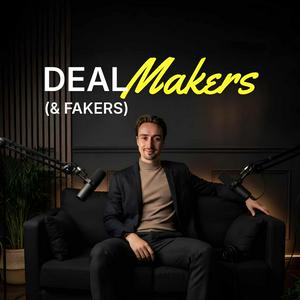
Über Deal Makers (& Fakers) Podcast
Deal Makers (& Fakers) is my podcast where fundraising gets real. No polished success stories. No fake LinkedIn wins. dealmakersandfakers.substack.com
Podcast-WebsiteHöre Deal Makers (& Fakers) Podcast, Das KI-Kochbuch mit Malcolm Werchota und viele andere Podcasts aus aller Welt mit der radio.at-App
Hol dir die kostenlose radio.at App
- Sender und Podcasts favorisieren
- Streamen via Wifi oder Bluetooth
- Unterstützt Carplay & Android Auto
- viele weitere App Funktionen
Hol dir die kostenlose radio.at App
- Sender und Podcasts favorisieren
- Streamen via Wifi oder Bluetooth
- Unterstützt Carplay & Android Auto
- viele weitere App Funktionen

Deal Makers (& Fakers) Podcast
Code scannen,
App laden,
loshören.
App laden,
loshören.
 Österreich