

Höre diesen Podcast kostenlos in der App: Kostenlos im App Store laden
radio.at
Sleeptimer
Sender speichern
92 Episoden
Can the Phenomenon Be Both Hardware & Consciousness?
04.10.2026 | 1 Std. 7 Min.In this episode of Need to Know, Bryce Zabel and Richard Dolan break down the sixth government UAP file release, including the newly released videos, historical documents, and 37 AAWSAP research papers exploring subjects like warp drives, traversable wormholes, advanced propulsion, and other frontier technologies. They also revisit Edward Ruppelt, Project Blue Book, and the remarkable continuity between what officials were saying about unexplained objects in 1952 and what government agencies are still saying today.
The conversation then turns to one of the biggest questions surrounding the phenomenon: Can UFOs be both physical technology and something connected to consciousness? Bryce shares the story behind the mysterious diagram given to him and Brent Friedman by a man claiming to be with the Office of Naval Intelligence at the 1996 Dark Skies premiere party. The drawing, later connected to concepts involving chakras, sound, light, frequency, and consciousness, raises deeper questions about why intelligence officials may have been interested in introducing these ideas into popular culture.
Bryce and Richard also explore remote viewing, the government's historic research into consciousness, Hal Puthoff and Russell Targ's work at SRI, and whether the UFO phenomenon itself may be forcing humanity to reconsider the relationship between mind, matter, and reality. The episode closes with new discussion surrounding former Secretary of Energy John Herrington, Brent Friedman's extraordinary 1981 story, and why these decades-old connections may still matter to the modern disclosure conversation.
TAPO Link:
https://us.store.tapo.com/products/tapo-c645d-kitWhat Should We Tell The Children?
06.09.2026 | 1 Std. 9 Min.How should we talk to children about UFOs, unexplained phenomena, and other sensitive subjects? In this episode of Need To Know, Bryce Zabel and special guest Ben Hansen explore how parents, teachers, and trusted adults can approach these conversations with honesty, care, and age-appropriate language—without creating unnecessary fear or dismissing a child's natural curiosity.
They discuss the importance of separating confirmed facts from speculation, encouraging thoughtful questions, and helping young people feel safe when confronting uncertainty. Whether the subject involves UFOs, government secrecy, frightening news, or the possibility of life beyond Earth, the goal is not to provide every answer—it is to build trust, promote critical thinking, and remind children that it is okay not to know.Whose Narrative Is It Anyway?
02.08.2026 | 1 Std. 17 Min.In this episode of Need to Know, Bryce Zabel and Richard Dolan examine the recent Ross Coulthart–UAP Gerb interview and the accusations directed at Lue Elizondo, asking who is shaping the narrative—and what evidence supports the competing claims. Bryce also recounts his appearance on Dr. Phil and considers whether Donald Trump may be positioning the television personality as a trusted public voice for Disclosure. Finally, Richard expands on his concept of a "breakaway civilization": a hidden, highly compartmentalized world with access to advanced knowledge and technology, operating beyond the awareness and perhaps the control of conventional government.Is the Tic Tac Really Lockheed Martin Technology?
14.06.2026 | 1 Std. 16 Min.In this episode of Need to Know, Bryce Zabel and Richard Dolan revisit one of the most debated claims in modern ufology: Ross Coulthart's statement that the famous Nimitz "Tic Tac" UFO was Lockheed Martin technology. They carefully examine what was actually said, why the claim generated so much discussion, and whether the available evidence supports such a conclusion. Along the way, they explore the long history of Lockheed's connection to classified aerospace programs, the challenges of relying on anonymous intelligence sources, and the importance of separating speculation from verifiable evidence.
The conversation expands into the broader question of whether some UFO encounters could be explained by advanced human technology or whether the evidence continues to point toward a genuine non-human intelligence. Bryce and Richard discuss the implications of black-budget programs, reverse engineering, the role of private aerospace contractors, and why landmark cases like the 2004 Nimitz encounter remain some of the strongest evidence in the UAP debate. They also reflect on the current state of disclosure, recent developments in Washington, and why the search for answers is far from over.
The episode also features a lighthearted opening on the "GOAT" of ufology, where Bryce and Richard debate who deserves a place on the Mount Rushmore of UFO research, highlighting figures such as Jacques Vallée, J. Allen Hynek, Stanton Friedman, and George Knapp. Blending humor with thoughtful analysis, the discussion ultimately returns to the biggest question facing the field today: if disclosure is a process rather than a single event, how do we responsibly separate compelling evidence from extraordinary claims?Does Spielberg Land Disclosure Day?
10.06.2026 | 9 Min.In this episode, Bryce Zabel offers his perspective on Disclosure Day not simply as a movie, but as a cultural milestone in the UFO conversation. He examines how Steven Spielberg approaches the subject, what the film gets right, where it takes creative liberties, and whether it succeeds as a meaningful disclosure story for a mainstream audience. More importantly, Bryce explores the larger question: if humanity were faced with undeniable evidence of a non-human presence, would our reaction resemble Spielberg's vision, or would the reality be far more complicated?
Weitere Dokumentation Podcasts






Trending Dokumentation Podcasts


Über Need To Know
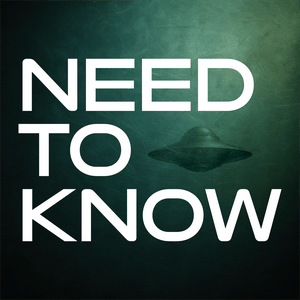
Need to Know is a smart, serious, and accessible podcast about the reality of UFOs/UAP and what the phenomenon may mean for all of us. Produced by Stellar Productions, the show is hosted by award-winning writer/producer and former CNN correspondent Bryce Zabel, who continues the signature UFO/UAP conversation format he helped pioneer: informed, evidence-driven, open-minded, and focused on what the public has a right to know.
Today, Need to Know features Bryce in conversation with historian Richard Dolan, one of the field's most respected researchers and authors. Together, they examine breaking news, government disclosures, historic cases, credible witnesses, official documents, and the shifting landscape of Disclosure. The show also includes expanded formats such as Project Book Club with Chrissy Newton, Need to Know Xtra with Tyler Stevens, and other special episodes that explore the mystery from fresh angles.
From 2021 to 2025, Bryce co-hosted Need to Know with investigative journalist Ross Coulthart. Their collaboration helped define the show's distinctive mix of journalism, analysis, historical context, and plainspoken curiosity. In 2025, Ross moved on to host Reality Check for NewsNation, while Bryce continued the Need to Know mission and also agreed to produce Sound, Light & Frequency for iHeartPodcasts.
With exclusive interviews, breaking-news analysis, hidden history, and thoughtful commentary grounded in evidence, Need to Know guides listeners through the noise and toward understanding. The questions remain urgent: What is happening in our skies? What do governments know? Who — or what — may be behind the phenomenon? And what happens next?
Stellar Productions is the production company of Bryce and Jackie Zabel. Its work spans television, film, books, and podcasts, with credits including the NBC UFO series Dark Skies, the Syfy original film Official Denial, the Disney animated feature Atlantis: The Lost Empire, the WGA Award-winning limited series Pandemic, the UFO disclosure book A.D. After Disclosure, and the podcasts Need to Know and Sound, Light & Frequency.
Podcast-WebsiteHöre Need To Know, Behind The Games - Wer den Sport kontrolliert und viele andere Podcasts aus aller Welt mit der radio.at-App
Hol dir die kostenlose radio.at App
- Sender und Podcasts favorisieren
- Streamen via Wifi oder Bluetooth
- Unterstützt Carplay & Android Auto
- viele weitere App Funktionen
Hol dir die kostenlose radio.at App
- Sender und Podcasts favorisieren
- Streamen via Wifi oder Bluetooth
- Unterstützt Carplay & Android Auto
- viele weitere App Funktionen
Need To Know
Code scannen,
App laden,
loshören.
App laden,
loshören.
 Österreich