

Höre diesen Podcast kostenlos in der App: Kostenlos im App Store laden
radio.at
Sleeptimer
Sender speichern
52 Episoden
#52 Michael Sailstorfer
25.09.2026 | 35 Min.In Berlin, a gallery floor is disappearing, one stone at a time.
In this episode of The Art Bystander Podcast, Roland-Philippe Kretzschmar meets Michael Sailstorfer at Galerie Judin’s Mercator Höfe space for a conversation about artistic freedom, physical labour and the uncertainty that runs through the German artist’s latest installation, Pull the Rug.
Around 11,000 paving stones cover the exhibition floor. Every 50 seconds, a worker removes one and feeds it through an opening in the wall. A concealed machine then propels it into an adjoining room, sending the sound and vibration of its impact back into the gallery. Over the course of the exhibition, the floor is gradually removed, exposing the sand beneath.
Born in Bavaria in 1979, Sailstorfer grew up around his family’s stone workshop before studying at the Academy of Fine Arts in Munich and Goldsmiths in London. Now based in Berlin, he has spent more than two decades expanding sculpture through movement, sound, scent and processes of transformation and destruction.
Their conversation moves from his childhood and early ambitions to the pressures of finding success while still at art school, the importance of working directly with materials, and the unpredictable relationship between an idea and its realisation. Sailstorfer explains why he once considered becoming a farmer or an architect, and why the freedom of art ultimately persuaded him to take another path.
Returning to Pull the Rug, they discuss the stability he remembers from his own childhood, the world his children are growing up in, and the uneasy proximity of repetitive labour, contemplation and aggression. A simple act of feeding a stone into a wall becomes the starting point for a wider discussion about machinery, responsibility and what happens when the consequences of our actions are hidden from view.
Recorded at Galerie Judin, Berlin, during Berlin Art Week 2026.
Michael Sailstorfer: Pull the Rug
10 September to 10 October 2026
Galerie Judin, Mercator Höfe, Berlin
Explore Michael Sailstorfer’s work
Exhibition information at Galerie Judin
Hosted on Acast. See acast.com/privacy for more information.#51 Erwin Wurm
22.09.2026 | 37 Min.In this episode of The Art Bystander Podcast, Roland-Philippe Kretzschmar is joined by Erwin Wurm on the occasion of Mind Bubbles & More at Carling Dalenson in Stockholm, running from 22 September to 31 October 2026. One could easily say Erwin Wurm is one of the world's most recognized and respected artists today.
Born in Bruck an der Mur, Austria, in 1954, Wurm has spent more than four decades expanding what sculpture can be, finding material in clothing, furniture, cars, houses and the human body. He originally wanted to become a painter, but found himself placed in a sculpture department. His response was to keep testing the discipline until he could make it his own, eventually returning to painting through works he calls Flat Sculptures.
That resistance to a fixed definition runs through his practice. In the 1992 video 59 Positions, a man and his sweater move through a sequence of poses, making sculpture out of the changing relationship between a body and its clothes. His later One Minute Sculptures invite participants to follow instructions involving everyday objects, adopting positions that can be awkward, funny or difficult to maintain. A sculpture exists briefly through someone's willingness to take part, with balance, embarrassment and the presence of an audience becoming part of the work.
Wurm's distorted objects extend these questions into the things we buy and inhabit. In his Fat Car series, luxury vehicles acquire swollen bodies, exaggerating the excess already associated with them. Fat House turns domestic security into something ungainly and overgrown, while Narrow House compresses his childhood home into proportions that make moving through it uncomfortable. Possessions become a way of examining the expectations attached to success, respectability and belonging.
These works can also be understood against the background of Wurm's childhood in postwar Austria, where the recent Nazi past often remained unspoken and conformity shaped everyday life. The absurd gives him a way of approaching the habits people accept without much examination. Following an instruction, dressing correctly or choosing a particular car becomes material for thinking about how we learn to fit in.
There is a useful connection here with Pierre Bourdieu's account of taste and social distinction: the objects around us communicate class and aspiration, whether or not we intend them to. Wurm makes those objects physically strange enough for their social meanings to become harder to overlook. His humour can leave us wondering why we laughed, and how much of our own behaviour we recognise.
Mind Bubbles & More brings together three-dimensional sculptures and recent Flat Sculptures. The Mind Bubbles borrow the familiar thought-bubble form from comic books while withholding the words or images we expect to find inside. The viewer supplies an imagined thought, continuing Wurm's interest in participation through an encounter that takes place in the mind.
Across sculpture, performance, photography, video and painting, Wurm returns to questions of volume, identity and perception. Wurm’s work is held in major public collections including the Solomon R. Guggenheim Museum, Centre Pompidou, and Walker Art Center. He has received Austria’s Grand State Prize for Fine Arts (2013), the GNMH Award (2021), and an honorary doctorate from the University of Belgrade (2022). He is represented by Thaddaeus Ropac, Lehmann Maupin, and König Galerie.
An introduction to an artist whose work makes the everyday a subject of sustained scrutiny, from the clothes on our bodies to the instructions we follow and the homes we build around ourselves. And be ready for some laughter!
Hosted on Acast. See acast.com/privacy for more information.#50 Cy Schnabel
18.09.2026 | 43 Min.“If I was going to open a gallery, it needed to have a very personal identity.” I met Cy Schnabel at Villa Magdalena in Madrid during Apertura Madrid Gallery Weekend to record a conversation for The Art Bystander podcast.
Born in New York in 1993 to Julian Schnabel and Basque designer Olatz López Garmendia, Cy grew up around artists, filmmakers and musicians, with access to his father’s studio from childhood. He studied political science at Bard, imagining a future in journalism, before moving to Mexico City and discovering exhibition-making through the Centro Cultural de España en México.
“I just discovered that curating was a storytelling medium.”
Villa Magdalena opened in 2020 in Julian’s former studio at the family home on Monte Igueldo in San Sebastián. The setting was personal: summers spent surfing with his twin brother, his mother’s Basque heritage, and his work on the archive of his uncle, Alejandro Garmendia, whose estate remains central to the gallery.
Madrid followed in June 2025. Opposite San Nicolás, away from the city’s established gallery concentrations, Cy found a space whose history appealed to him, with timber beams concealed beneath plaster. The move gave his artists greater visibility and a permanent base in a city he sees as an essential connection between Europe and Latin America.
His programme returns to narrative painting, symbolic figuration and the ways mythology and folklore survive in images. He writes the texts and curates the exhibitions himself, working with emerging artists alongside older practices that deserve renewed attention.
There is a practical responsibility behind that commitment. Artists need sales, and developing an audience for a body of work can take several exhibitions. “I’m running a business,” he says.
We spoke about the privileges and assumptions attached to the Schnabel name, his admiration for his father’s painting, and the years of attention an artist’s work requires. His response to questions of inheritance is an invitation to look at what he has made: “People can judge me based on my work.”
Hosted on Acast. See acast.com/privacy for more information.#49 Anne Vieth & Philipp Solf
07.09.2026 | 30 Min.Berlin’s cultural power was built on cheap space, unfinished buildings and artists willing to live precariously. The city is wealthier now, but can the people who created its value still afford to remain?
For this episode of The Art Bystander Podcast, Roland-Philippe Kretzschmar speaks with Philipp Solf, entrepreneur, collector and one of the people behind Wilhelm Hallen and HALLEN 07, and Dr Anne Vieth, Head of the Mercedes-Benz Art Collection.
Why does Solf resist calling HALLEN an art fair? What happens when contemporary art turns an industrial building into a desirable address? And what does a company such as Mercedes-Benz owe the culture from which it draws prestige?
Vieth takes us inside SEEING FORMS, the collection’s exhibition at HALLEN 07, and speaks about using art to unsettle habits within a corporation. Solf is equally candid about art’s power to position property within a city, bringing the conversation to gentrification, public funding and who gains when culture makes an address valuable. This is a conversation about how Berlin might become wealthier without driving out the artists who made it culturally necessary.
Hosted on Acast. See acast.com/privacy for more information.#48 Michèle Lamy & Scarlett Rouge
23.08.2026 | 47 Min.In this episode of The Art Bystander, Roland-Philippe Kretzschmar enters a conversation with Michèle Lamy and Scarlett Rouge.
Michèle Lamy is often introduced in relation to Rick Owens, but that has always felt like an incomplete way of understanding her.
Born in France’s Jura region in 1944, into a family shaped by the Resistance, Lamy studied law in Lyon, attended the philosophy lectures of Gilles Deleuze and worked as a criminal defence lawyer while also performing striptease and cabaret.
In 1979, she moved to Los Angeles without having visited the city. There she established her clothing line, created Café des Artistes and Les Deux Cafés, and treated hospitality as a form of theatre.
Around 1990, she hired a pattern cutter named Rick Owens. Their working relationship became a partnership in life, and by 2003 they had moved to Paris and were building Owenscorp together. Lamy’s work has since moved through furniture, jewellery, music, film, performance and boxing. She has variously described herself as a storyteller, performer and entrepreneur, resisting any single professional title.
Joining her is her daughter, Scarlett Rouge, an interdisciplinary artist raised between California and France. The daughter of Lamy and experimental filmmaker Richard Newton, and Owens’s stepdaughter, Rouge trained in photography at CalArts before developing a practice across painting, installation, sculpture, video, textiles and performance.
Her work draws on myth, symbolic language, Jungian thought and ritual, asking how art might reconnect spirit and matter. Mother and daughter have also performed together in LAVASCAR alongside Nico Vascellari.
In this episode, we speak about resistance and freedom, Los Angeles, family and artistic inheritance, collaboration, ritual, commerce and the making of spaces in which outsiders can belong.
Hosted on Acast. See acast.com/privacy for more information.
Weitere Design Podcasts
 Likovni odmeviDesign, Kunst
 Der kreative Flow – Entfalte Deine kreative Stimme!Design, Freizeit, Hobbys, Kunst
 The Art ElevatorBildende Kunst, Design, Kunst
 99% InvisibleDesign, Kunst
 Creative Pep TalkBildung, Design, Kunst, Wirtschaft
 Vom Portfolio zur Marke | Business-Strategien für KreativeBildung, Design, Karriere, Kunst, Selbstverwirklichung, Wirtschaft
 The Good Ship IllustrationDesign, Kunst
 DDCAST - Was ist gut? Design, Kommunikation, ArchitekturDesign, Kunst
Trending Design Podcasts


Über The Art Bystander
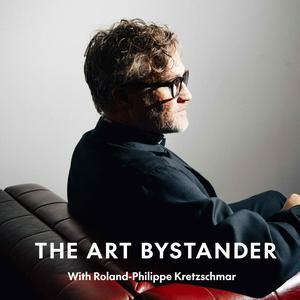
Meet the individuals who drive the art industry today and tomorrow; from artists to gallerists, curators, financial backers, advisors, collectors, and more. Hosted by Roland-Philippe Kretzchmar.More on www.theartbystander.com and www.instagram.com/theartbystander Hosted on Acast. See acast.com/privacy for more information.
Podcast-WebsiteHöre The Art Bystander, Likovni odmevi und viele andere Podcasts aus aller Welt mit der radio.at-App
Hol dir die kostenlose radio.at App
- Sender und Podcasts favorisieren
- Streamen via Wifi oder Bluetooth
- Unterstützt Carplay & Android Auto
- viele weitere App Funktionen
Hol dir die kostenlose radio.at App
- Sender und Podcasts favorisieren
- Streamen via Wifi oder Bluetooth
- Unterstützt Carplay & Android Auto
- viele weitere App Funktionen
The Art Bystander
Code scannen,
App laden,
loshören.
App laden,
loshören.
 Österreich