PodcastsBildungThe Global Lens - Science Diplomacy in Focus

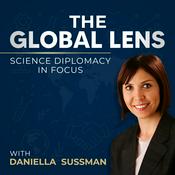
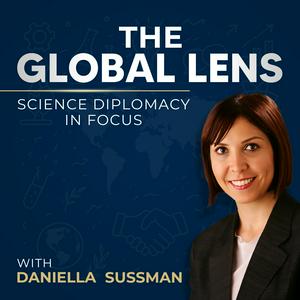
The Global Lens - Science Diplomacy in Focus

Daniella Sussman
The Global Lens - Science Diplomacy in Focus
Neueste Episode

11 Episoden

  • The Global Lens - Science Diplomacy in Focus

    EP10 Can Scientists Succeed Where Politicians Fail? Featuring Dr. Peter Agre

    06.03.2026 | 21 Min.
    OVERVIEW
    Science Diplomacy takes center stage in this episode of The Global Lens, where Nobel Laureate Dr. Peter Agre of Johns Hopkins University reflects on how scientific collaboration can advance international relations in ways politics cannot. Through his remarkable experiences in global engagement and research, Dr. Agre reveals how empathy, evidence, and dialogue remain the most powerful tools for bridging divides.
    EPISODE SUMMARY
    In a moving conversation with host Daniella Sussman, Dr. Agre recounts his extraordinary journey from molecular biologist to global envoy for peace. Drawing from his new book Can Scientists Succeed Where Politicians Fail?, he shares personal stories from North Korea, Cuba, and Iran—moments where shared scientific curiosity opened channels of trust amidst deep conflict. He discusses how science diplomacy can protect researchers, strengthen international partnerships, and foster hope even in divided times. Listeners will gain insight into how education, compassion, and persistence can turn science into a force for global cooperation.

    In this episode, we discuss:
    00:48 - Curiosity and empathy as foundations for a life in science and global engagement
    03:34 - How recognition in science can evolve into a platform for dialogue and cooperation
    05:29 - Science as a language of trust in politically divided places like Cuba and North Korea
    07:44 - Lessons in humility and respect from diplomatic exchanges across geopolitical divides
    13:55 - Institutions protecting openness and collaboration in global research
    17:12 - Mentorship and education shaping the next generation of globally minded scientists
    20:41 - Science diplomacy as a bridge for peace, understanding, and shared progress

    ABOUT THE GUEST
    Peter Agre, awarded the 2003 Nobel Prize in Chemistry for discovering aquaporins, is a physician, molecular biologist, and Director of the Johns Hopkins Malaria Research Institute. As former President of the American Association for the Advancement of Science (AAAS), he has led scientific delegations around the world, advancing cooperation across political divides to address shared global scientific challenges. Dr. Agre champions science diplomacy as a vital tool for international cooperation.

    MENTIONED IN THE EPISODE:
    ⚇ (Book) Can Scientists Succeed Where Politicians Fail? by Dr. Peter Agre and Dr. Seema Yasmin - https://www.amazon.com/Scientists-Succeed-Politicians-Hopkins-Wavelengths/dp/1421452995
    ⚇ (Studies or Research) Discovery of the Aquaporins and Their Impact on Basic and Clinical Physiology - https://pmc.ncbi.nlm.nih.gov/articles/PMC7129575/pdf/main.pdf
    ⚇ (Website) Johns Hopkins Malaria Research Institute - https://publichealth.jhu.edu/malaria-research-institute
    ⚇ (Website) American Association for the Advancement of Science (AAAS) - https://www.aaas.org/
    ⚇ (Reference) Science Magazine - https://www.science.org/

    ————
    This episode is brought to you by Global Signals, a curated bi-weekly paid newsletter for globally minded policymakers, international researchers, strategic industry leaders, and investors.
    Subscribe here: https://tinyurl.com/Global-Lens
    ————

    CONNECT WITH DR. PETER AGRE:
    ⚇ Website: https://bdp.jhu.edu/bd-professors/peter-agre/

    CONNECT WITH DANIELLA:
    ⚇ Podcast Website: https://the-global-lens.captivate.fm/
    ⚇ LinkedIn: https://www.linkedin.com/in/daniellasussman/
    ⚇ Instagram: https://www.instagram.com/daniellasussmanglobal/
  • The Global Lens - Science Diplomacy in Focus

    EP9 Inspiring Talk Series with Ugo Amaldi

    09.02.2026 | 28 Min.
    OVERVIEW
    In this episode of The Global Lens, host Daniella Sussman speaks with Professor Ugo Amaldi about science diplomacy and international scientific collaboration through the lens of CERN and global research cooperation. Drawing on decades of leadership in large-scale experiments, Amaldi reflects on how sustained partnerships shape the future of research, from quantum technologies to medical innovation. The conversation highlights how collaborative science advances discovery while building trust across geopolitical boundaries.
    EPISODE SUMMARY
    From Cold War collaborations with Soviet scientists to pioneering CERN experiments and advancing cancer therapy with hadron beams, this episode traces the evolution of global scientific cooperation. Amaldi shares lessons learned from managing large international teams, translating fundamental physics into life-saving treatments, and establishing durable networks across nations. The conversation also examines disparities in research investment within Europe and advocates for sustained, long-term commitment to science as a foundation for diplomacy and progress. Throughout, collaboration is presented not just as an ideal, but as a practical necessity for advancing knowledge and fostering peace.
    In this episode, we discuss:
    01:41 – Introduction to the importance of international scientific collaboration
    03:30 – Cold War era science and cross-cultural cooperation with Soviet physicists
    04:10 – Building large-scale international collaborations at CERN
    05:54 – Balancing innovation and stability in complex experiments
    09:08 – Transition from work in particle physics to pioneering cancer therapy
    18:20 – European disparities in research funding and investment
    21:35 – Advice to future scientists: curiosity, optimism, and collaboration

    ABOUT THE GUEST
    Ugo Amaldi is a particle physicist and pioneer in hadron therapy. A CERN Scientist Emeritus, he co-discovered the rising proton-proton cross section in 1973, founded and led the 500-member DELPHI collaboration at LEP, and proposed the cyc-linac accelerator for cancer treatment. In 1992 he created the TERA Foundation, leading to Italy’s CNAO center and influencing facilities worldwide. As Scientific Director of the Tera-Care Foundation, he now advances clinical helium facilities with CERN. Author of more than 600 papers (h-index 83), accelerator physics textbooks, and popular science books including Particle Accelerators: From Big Bang Physics to Hadron Therapy (Springer). Co-author of ~40 physics textbooks used by millions of students globally.

    MENTIONED IN THE EPISODE:
    ⚉ (Reference) European Organization for Nuclear Research (CERN) - https://home.cern/
    ⚉ (Studies or Research) DELPHI experiment - https://home.cern/science/experiments/delphi
    ⚉ (Reference) National Center for Oncological Hadrontherapy (CNAO) - https://fondazionecnao.it/en/
    ⚉ (Reference) European Network for Hadron Therapy (ENLIGHT) - https://enlight.web.cern.ch/

    CONNECT WITH UGO AMALDI:
    ⚉ Inspire HEP: https://inspirehep.net/

    CONNECT WITH DANIELLA:
    ⚉ Podcast Website: https://glsd.ai/
    ⚉ LinkedIn: https://www.linkedin.com/in/daniellasussman/
    ⚉ Instagram: https://www.instagram.com/daniellasussmanglobal/
  • The Global Lens - Science Diplomacy in Focus

    EP8 AI and Higher Education: Dakota State's Cyber Vision with Dr. José-Marie Griffiths

    26.01.2026 | 27 Min.
    OVERVIEW
    This episode of The Global Lens explores the intersection of artificial intelligence, cybersecurity, and science diplomacy, and how these forces are transforming national security and global cooperation. Daniella Sussman and Dr. José-Marie Griffiths explore Dakota State University’s role in turning applied AI research into real-world impact. Education emerges as a strategic force and soft power in the evolving AI landscape.
    EPISODE SUMMARY
    Dr. Griffiths reflects on transforming Dakota State University into a cyber and AI powerhouse by aligning research, policy, and workforce development. She outlines how applied labs, global partnerships, and inclusive education models help translate innovation into real-world impact. The episode also explores how higher education can function as science diplomacy by building trust, shared standards, and ethical AI frameworks across borders. Throughout, Dr. Griffiths stresses the responsibility educators and policymakers share in shaping AI to benefit society rather than control it.
    In this episode, we discuss:
    01:39 - Building Dakota State’s strong and advanced cyber-AI foundation
    04:08 - AI's transformative and evolving impact on higher education
    07:16 - Empowering accessible and ethical global AI innovation through inclusion
    09:32 - Higher education driving real-world global impact and discovery
    15:00 - Shaping ethical global AI standards and open data sharing
    17:37 - Policymakers learning from DSU's integrated AI education approach
    24:31 - Ensuring responsible AI design, development, and collaboration
    ABOUT THE GUEST
    Dr. José-Marie Griffiths is President of Dakota State University, where she has led transformational growth since 2015. Her leadership and contributions have earned her more than 20 major awards, including recognition as a USA Today Woman of the Year and one of InspiredMinds!’ 50 Influential Women in AI.
    A physicist and information scientist by training, Dr. Griffiths has held leadership roles across research, government, and higher education, with a special focus on STEM and cyber fields. She has served on the National Science Board, the U.S. President’s Information Technology Advisory Committee, and the National Security Commission on Artificial Intelligence. Today, she continues this work as an advisor to the Special Competitive Studies Project (SCSP).
    Dr. Griffiths has led projects with more than 28 federal agencies, including NASA and the Department of Energy, collaborated with major corporations such as IBM and Apple, and partnered with international organizations including NATO and the United Nations.

    MENTIONED IN THE EPISODE:
    ⚉ (Reference) Madison Cyber Labs (MAD Labs) - https://dsu.edu/research/madison-cyber-labs/
    ⚉ (Reference) Google Cybersecurity Clinics Fund - https://cyberclinics.withgoogle.com/
    ⚉ (Reference) Dakota State's Governors Cyber Academy - https://dsu.edu/admissions/undergraduate/cyber-academy.html
    ⚉ (Reference) Dakota State Applied Research Corporation (DARC) - https://dsu-arc.org/

    ————
    This episode is brought to you by Global Signals, a curated bi-weekly paid newsletter for globally minded policymakers, international researchers, strategic industry leaders, and investors.
    Subscribe here: https://tinyurl.com/Global-Lens
    ————

    CONNECT WITH DR. JOSÉ-MARIE GRIFFITHS:
    ⚉ Website: https://dsu.edu/directory/griffiths-jose-marie.html
    ⚉ X (Twitter): https://x.com/josegriffiths
    ⚉ LinkedIn: https://www.linkedin.com/in/jose-marie-griffiths-9106b7b/

    CONNECT WITH DANIELLA:
    ⚉ Podcast Website: https://the-global-lens.captivate.fm/
    ⚉ LinkedIn: https://www.linkedin.com/in/daniellasussman/
    ⚉ Instagram: https://www.instagram.com/daniellasussmanglobal/
  • The Global Lens - Science Diplomacy in Focus

    EP7 Expanding the U.S.–India Research Corridor with Neetisha Besra

    22.12.2025 | 40 Min.
    OVERVIEW
    Science Diplomacy sits at the center of International Relations and US-India cooperation in this episode of The Global Lens, where host Daniella Sussman speaks with Neetisha Besra about building durable research bridges between the two countries. The conversation examines how academic institutions, policy frameworks, and people-to-people ties are shaping a deeper and more strategic U.S.–India partnership.
    EPISODE SUMMARY
    This episode explores how research collaboration has become a powerful diplomatic tool between the United States and India. Neetisha Besra offers insight into how universities operate as connectors across governments, disciplines, and borders. The discussion highlights the practical work behind sustaining long-term partnerships, from navigating policy environments to aligning institutional priorities. Listeners gain a grounded view of how global challenges are increasingly addressed through collaborative research ecosystems rather than bilateral politics alone.
    In this episode, we discuss:
    00:46 - Setting the stage for the U.S.–India research corridor
    01:48 - Why 2025–2026 marks a critical window for the U.S.–India scientific partnership
    07:15 - The research corridor as a living, operational ecosystem
    10:05 - Institutional programs enabling sustained bilateral collaboration
    13:21 - India RISE Fellowship and supporting women scientists in STEM
    18:58 - Breakthrough grants and catalytic funding for high-risk research
    29:29 - Measuring diplomatic impact beyond papers and patents

    ABOUT THE GUEST
    Neetisha Besra is the Director for the Gupta-Klinsky India Institute in India at Johns Hopkins University. Based in New Delhi, she leads GKII’s India strategy, partnerships, and operations to strengthen U.S.–India collaborations in research, education, and policy. She holds an MPA in International Development from Harvard Kennedy School, a Master’s in Development Practice from the Tata Institute of Social Sciences, and a Bachelor of Technology from IIT Kanpur.

    MENTIONED IN THE EPISODE:
    ⚉ (Website) Gupta-Klinsky India Institute at Johns Hopkins University - https://indiainstitute.jhu.edu/
    ⚉ (Reference) Indo-U.S. Science and Technology Forum - https://iusstf.org/
    ⚉ (Reference) Fulbright-Nehru Scholarship Program - https://www.usief.org.in/fulbright-fellowships/fellowships-for-indian-citizen/
    ⚉ (Reference) The NASA-ISRO Synthetic Aperture Radar - https://science.nasa.gov/mission/nisar/
    ⚉ (Reference) India RISE Fellowship - https://indiainstitute.jhu.edu/our-initiatives/indiarise/
    ⚉ (Reference) TB Free Schools Initiative - https://indiainstitute.jhu.edu/our-initiatives/tb-free-schools-initiative/

    ————
    This episode is brought to you by Global Signals, a curated bi-weekly paid newsletter for globally minded policymakers, international researchers, strategic industry leaders, and investors.
    Subscribe here: https://tinyurl.com/Global-Lens
    ————

    CONNECT WITH NEETISHA BESRA:
    ⚉ Website: https://indiainstitute.jhu.edu/directory/neetisha-besra/
    ⚉ LinkedIn: https://www.linkedin.com/in/neetishabesra/
    ⚉ X (Twitter): https://x.com/NeetishaBesra

    CONNECT WITH DANIELLA:
    ⚉ Podcast Website: https://the-global-lens.captivate.fm/
    ⚉ LinkedIn: https://www.linkedin.com/in/daniellasussman/
    ⚉ Instagram: https://www.instagram.com/daniellasussmanglobal/
  • The Global Lens - Science Diplomacy in Focus

    EP6 Radical AI: Changing How The World Innovates with Joseph F. Krause

    15.12.2025 | 41 Min.
    OVERVIEW
    As global research ecosystems modernize and AI reshapes scientific infrastructure, host Daniella Sussman and guest Joseph F. Krause examine how science diplomacy, materials science, and AI are converging to redefine how nations and industries pursue technological breakthroughs. Their exchange underscores the accelerating transition toward autonomous discovery, where governments, national labs, and private innovators collaborate to build next-generation research capabilities.
    EPISODE SUMMARY
    This conversation charts Radical AI’s emergence as a technical and strategic force, detailing how autonomous labs, large-scale data generation, and machine-learned simulations are restructuring the scientific process. Joseph outlines the shift from serial to parallel discovery, the role of open-source tools in expanding global participation, and the policy frameworks now shaping AI-native research programs. The discussion illustrates why materials development is becoming a geopolitical priority and how collaboration, infrastructure, and policy alignment are essential to remain competitive. By integrating scientific insight with national-level strategy, the episode positions the future of discovery as both a technological and diplomatic undertaking.
    In this episode, we discuss:
    03:06 – The founding vision behind Radical AI
    07:30 – Redefining the scientific workflow through parallel discovery
    11:18 – How TorchSim and open-source tools expand global access
    17:39 – The intensifying race for scientific leadership and the global stakes of AI-native research
    20:52 – Data availability, global standards, and international collaboration
    23:30 – Who shapes global AI standards and how Radical AI contributes to that future
    39:02 – The future vision of removing materials as a global bottleneck

    ABOUT THE GUEST
    Joseph F. Krause is Co-Founder and CEO of Radical AI, which combines AI and robotics to accelerate the design, development, and discovery of novel materials. A U.S. Army National Guard veteran and trained materials scientist, he pioneered neuromorphic semiconductor research at the Army DEVCOM research lab and later led deep tech investments at AlleyCorp before founding Radical.
    Radical AI is building a unified scientific intelligence platform that autonomously discovers, designs, and manufactures advanced materials - bridging gaps between research, industry, and policy. The company’s work advances how national labs, industry, and international partners collaborate to shape global standards in AI infrastructure and scientific innovation.

    MENTIONED IN THE EPISODE:
    ⚇ (Studies or Research) Materials Project / Materials Genome Initiative - https://www.mgi.gov/content/materials-project
    ⚇ (Website) AI + Science Summit - https://www.scsp.ai/event/ai-science/
    ⚇ (Website / Tool) Torch Sim - https://github.com/TorchSim/torch-sim
    ⚇ (Reference) Open Catalyst Project - https://opencatalystproject.org/

    ————
    This episode is brought to you by Global Signals, a curated bi-weekly paid newsletter for globally minded policymakers, international researchers, strategic industry leaders, and investors.
    Subscribe here: https://tinyurl.com/Global-Lens
    ————

    CONNECT WITH JOSEPH F. KRAUSE:
    Website: https://www.radical-ai.com/
    LinkedIn: https://www.linkedin.com/in/josephfkrause/
    X (Twitter): https://x.com/josephfkrause/

    CONNECT WITH DANIELLA:
    Podcast Website: https://the-global-lens.captivate.fm/
    LinkedIn: https://www.linkedin.com/in/daniellasussman/
    Instagram: https://www.instagram.com/daniellasussmanglobal/
Weitere Bildung Podcasts

Über The Global Lens - Science Diplomacy in Focus

The Global Lens is a podcast showcasing science diplomacy through conversations with leaders at the forefront of innovation, research, and international partnerships. Hosted by Daniella Sussman, the show brings into focus how higher education institutions, research organizations, diplomats, policymakers, and private sector experts are building partnerships that address shared challenges and shape our future. Each episode highlights real-world collaboration across higher education, research institutions, government, and industry, exploring how diplomacy and partnership in science and technology are shaping strategic engagement around the world.
Podcast-Website

Höre The Global Lens - Science Diplomacy in Focus, Easy German: Learn German with native speakers | Deutsch lernen mit Muttersprachlern und viele andere Podcasts aus aller Welt mit der radio.at-App

Hol dir die kostenlose radio.at App

  • Sender und Podcasts favorisieren
  • Streamen via Wifi oder Bluetooth
  • Unterstützt Carplay & Android Auto
  • viele weitere App Funktionen
Rechtliches
Social
v8.8.6| © 2007-2026 radio.de GmbH
Generated: 4/2/2026 - 5:48:55 AM