
Höre diesen Podcast kostenlos in der App: Kostenlos im App Store laden
radio.at
Sleeptimer
Sender speichern
107 Episoden
Longing
24.10.2026 | 1 Std. 16 Min.We bring meanings to music that the composers often didn't intend. And this episode is going to be an example of that. There is something in some music that for me triggers a sort of longing. The writer and composer Jan Swafford describes some of Mozart's music as having a 'deep yearning' and I think that is in the same general area. And you can't be too prescriptive about this. It is a bit different if there are lyrics but music on its own is generally suggestive rather than specific. And when I describe the music I'm going to play as inspiring feelings of 'longing'… that in itself is a broad and perhaps vague concept… the music might bring up feelings of someone you have lost… or of a place you can't return to… maybe a golden time you can't recapture… or an ache for someone you can't be with.
And of course it may do none of those things for you but for the next hour and a bit there will be music with maybe a hint of melancholy or wistfulness or searching or longing… from Frederic Chopin, Maurice Ravel, Gabriel Fauré, Edward Elgar, Anton Arensky, Jean Sibelius, Arvo Pärt, Johann Sebastain Bach, Wolfgang Amadeus Mozart, Aram Khachaturian and Ludwig van Beethoven.
[Episode image: 'A distant star' Chania, Crete.]Sviatoslav Richter - Part One
18.10.2026 | 1 Std. 14 Min.The Soviet pianist Sviatoslav Richter, as I hope this and the following episode will illustrate, is one of the greatest musicians of the recording era… unsurpassed technical expertise matched with a profound depth of musicality. But those clichés (whilst true) could be applied to a not insignificant number of other players. So why Richter? More than most musicians he was touched by history. Born in 1915 and dying in 1997, he outlived the Soviet Union but his life was utterly entangled with that state and the impact its leaders had on the people under their iron fists, Richter included. There is I think something in Richter's absolute immersion in his music that was a result of these extraordinary times and his strategies to protect himself from them. And along with the first part of his story there will be music from Mussorgsky, Prokofiev, Beethoven, Schubert and Rachmaninoff.
[Episode Image: Richter c.1960 Time Life - Walter Sanders]Mozart Opera Overtures
10.10.2026 | 1 Std. 25 Min.Why Mozart Opera Overtures? Well, whilst they were not really intended to be stand-alone pieces they have in many instances become favourites of concert programmers and broadcasters, not to mention the public. And with most of them being about five minutes long you can fit eleven of them into a podcast episode! They are also in a way an interesting lens into the development of a composer… since Mozart wrote his first opera very early and completed two in the final year of his life. And in between he wrote another 15 to 20 operas depending on how you define them. So I'm going to play them in chronological order. And as a parallel they chart the changes in the make-up of a theatre orchestra in this time of intense development… the late 1760s to the early 1790s. What we think of as the modern orchestra was starting to settle at this time and the difference in the resources, in terms of instruments, Mozart had from the beginning of his career to the end is striking. And music is pretty damn sensational.
[Episode image: 'Cosi Fan Tutte' – Opera Australia.]Film Music
04.10.2026 | 1 Std. 24 Min.Who knew that Camille Saint-Saens of 'Carnival of the Animals' fame wrote the world's first film score? Or that the Pulitzer Prize for music has been given to only one work for the screen. Or that five composers, including the American music theatre legend Richard Rodgers, were approached for 'Lawrence of Arabia' before the job fell to an unknown Frenchman who was given six weeks to get the job done. Or that one of the great 20th century symphonies started out as music for a movie. Well I certainly didn't… until I started working on the 'Film Music' episode of 'Classical For Everyone'.
[Episode image: The Embassy Cinema; Wellington, New Zealand.]Diving For Pearls – Part Two
25.09.2026 | 42 Min.[Please feel free to leap straight into this second part of the 'Diving for Pearls' episode but there's background information in the first half you might enjoy if by chance you have missed it.]
How did the term 'baroque', the French version of a very old Portuguese word for a misshapen pearl… which became an insult applied to complicated music… and was then rehabilitated as a description of an ornate style of art and architecture… become the term now almost universally used to describe music written between 1600 and 1750? And what has 'diving' got to do with anything? The answers are in this two part episode of Classical For Everyone exploring lesser known Baroque composers. And there's a merman. But way more importantly… there is amazing music by Rameau, Rebel, Caldara, von Biber, Marais, Keiser, Leonarda, Strozzi, Stradella, Scarlatti, Locatelli and Valentini.
[Episode image: The Canning Jewel (reverse) – Collection, Victoria & Albert Museum.]
Weitere Musik Podcasts






Trending Musik Podcasts














Über Classical For Everyone
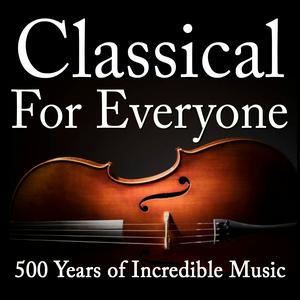
Five hundred years of incredible music. No expertise is necessary. All you need are ears. If you've ever been even slightly curious about classical music then this is the podcast for you.
Podcast-WebsiteHöre Classical For Everyone, ENERGY Club Files Podcast - Flip Capella und viele andere Podcasts aus aller Welt mit der radio.at-App
Hol dir die kostenlose radio.at App
- Sender und Podcasts favorisieren
- Streamen via Wifi oder Bluetooth
- Unterstützt Carplay & Android Auto
- viele weitere App Funktionen
Hol dir die kostenlose radio.at App
- Sender und Podcasts favorisieren
- Streamen via Wifi oder Bluetooth
- Unterstützt Carplay & Android Auto
- viele weitere App Funktionen
Classical For Everyone
Code scannen,
App laden,
loshören.
App laden,
loshören.
Classical For Everyone: Zugehörige Podcasts
 Österreich