
Höre diesen Podcast kostenlos in der App: Kostenlos im App Store laden
radio.at
Sleeptimer
Sender speichern
100 Episoden
No Equal Justice (Encore)
18.10.2026 | 35 Min.Labor History Today: LHT producer and host Chris Garlock toured the Reuther Library Archives last week with archivist and Tales from the Reuther Library host Dan Golodner; we'll share that tour in an upcoming episode of LHT. Meanwhile, here's one from our own archives...
The legal and civil rights legacy of George W. Crockett Jr., from the Tales from the Reuther Library podcast. Peter Hammer describes the life and legacy of Crockett, a Black lawyer who fought racism and defended constitutional rights in landmark cases from the 1940s through the 1960s. Hammer is an A. Alfred Taubman Endowed Chair in the Wayne State University Law School and director of the Damon J. Keith Center for Civil Rights.
Originally aired October 16, 2022. Labor History Today is produced by the Kalmanovitz Initiative for Labor and the Working Poor. Today’s show edited by Patrick Dixon and engineered by Chris Garlock.Solidarity Has a Long Memory
11.10.2026 | 29 Min.On Labor History Today: A Virginia road and a century-old song reveal how workers carry solidarity across generations.
Anthony Dominiczak of the Labor Memory Project takes us along Gravel Lick Road in Castlewood, Virginia, where a family memorial and an abandoned coal plant connect the Harlan County Coal War, the Pittston strike and a more recent fight over a landfill.
Then, marking Joe Hill’s 147th birthday, we share an episode from Solidarity Works, the United Steelworkers podcast. Chelsea Engle explores the immigrant worker, IWW organizer and songwriter whose songs still speak to working people today.
Plus, Rick Smith, with Labor History in 2:00.
Hosted by Chris Garlock. Labor History Today is produced by the Labor Heritage Foundation and Georgetown University’s Kalmanovitz Initiative for Labor and the Working Poor.
Explore more labor history and the Labor Landmarks Map at laborheritage.org.
Questions, comments, or suggestions are welcome, and to find out how you can be a part of Labor History Today, email us at LaborHistoryToday@gmail.com
Labor History Today is produced by the Labor Heritage Foundation and the Kalmanovitz Initiative for Labor and the Working Poor.
#LaborRadioPod #History #WorkingClass #ClassStruggle @GeorgetownKILWP #LaborHistory @UMDMLA @ILLaborHistory @AFLCIO @StrikeHistory #LaborHistory @wrkclasshistoryBuilt by Workers, Remembered by Workers
04.10.2026 | 29 Min.On Labor History Today: An automobile museum full of cars—but where are the workers who built them? Retired autoworker and union leader Mark Strolle helped answer that question with “Assembled in Lansing,” a new permanent exhibit at Michigan’s R.E. Olds Transportation Museum.
In this conversation with Chris Garlock, a shorter version of which originally aired on the Labor Heritage Power Hour, Strolle traces Lansing’s labor history through sit-down strikes, the successful one-day Lansing Labor Holiday, and the union contracts that helped generations of workers buy homes, send their children to college and retire with dignity.
He also shares his own experiences from 16 years on the assembly line: the physical toll, the unpredictable layoffs and the union community that helped workers weather both. And he connects that history to today’s challenges, from deindustrialization to AI and automation.
Plus, on Labor History in 2:00, Rick Smith remembers Woody Guthrie, the Dust Bowl troubadour whose songs spoke to working people’s struggles.
Questions, comments, or suggestions are welcome, and to find out how you can be a part of Labor History Today, email us at LaborHistoryToday@gmail.com
Labor History Today is produced by the Labor Heritage Foundation and the Kalmanovitz Initiative for Labor and the Working Poor.
#LaborRadioPod #History #WorkingClass #ClassStruggle @GeorgetownKILWP #LaborHistory @UMDMLA @ILLaborHistory @AFLCIO @StrikeHistory #LaborHistory @wrkclasshistory“Working History” Is Back on the Job
27.09.2026 | 29 Min.On Labor History Today: What can labor history teach us about the present—and the possibility of change? In this episode, we share excerpts from the relaunch of the Working History podcast. Beth English talks with historians Sarah McNamara, Julie Greene, Eileen Boris, and Mae Ngai about the many kinds of work and workers that belong in labor history, from immigrant and domestic workers to the people who built the Panama Canal. Plus, Rick Smith tells the story of Shays’ Rebellion on Labor History in 2:00.
Questions, comments, or suggestions are welcome, and to find out how you can be a part of Labor History Today, email us at LaborHistoryToday@gmail.com
Labor History Today is produced by the Labor Heritage Foundation and the Kalmanovitz Initiative for Labor and the Working Poor.
#LaborRadioPod #History #WorkingClass #ClassStruggle @GeorgetownKILWP #LaborHistory @UMDMLA @ILLaborHistory @AFLCIO @StrikeHistory #LaborHistory @wrkclasshistoryLabor Day, Solidarity Day and a Fight for Justice
20.09.2026 | 29 Min.On this week’s Labor History Today: Delta pilots trace the 1894 Pullman Strike’s connections to Labor Day and today’s airline labor law; more than 400,000 unionists march on Washington for 1981’s Solidarity Day; and Latin American tunnel workers wage a five-year fight against wage discrimination in Vancouver. Plus, Youngstown remembers the devastating steel-mill shutdown known as Black Monday.
Sources: Engage: The Podcast For Delta Pilots; On The Line: Stories of BC Workers; Labor History in 2:00
Music: Rails of Rage (Pullman Strike, 1894) - Bridget Roos
Questions, comments, or suggestions are welcome, and to find out how you can be a part of Labor History Today, email us at LaborHistoryToday@gmail.com
Labor History Today is produced by the Labor Heritage Foundation and the Kalmanovitz Initiative for Labor and the Working Poor.
#LaborRadioPod #History #WorkingClass #ClassStruggle @GeorgetownKILWP #LaborHistory @UMDMLA @ILLaborHistory @AFLCIO @StrikeHistory #LaborHistory @wrkclasshistory
Weitere Geschichte Podcasts










Trending Geschichte Podcasts





















Über Labor History Today
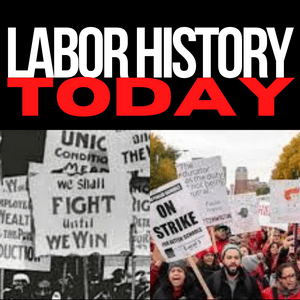
Gripping stories of the historic battles for worker rights and how they fuel today’s struggles. Part of the Labor Radio/Podcast Network: #LaborRadioPod
Podcast-WebsiteHöre Labor History Today, Alles Geschichte - Der History-Podcast und viele andere Podcasts aus aller Welt mit der radio.at-App
Hol dir die kostenlose radio.at App
- Sender und Podcasts favorisieren
- Streamen via Wifi oder Bluetooth
- Unterstützt Carplay & Android Auto
- viele weitere App Funktionen
Hol dir die kostenlose radio.at App
- Sender und Podcasts favorisieren
- Streamen via Wifi oder Bluetooth
- Unterstützt Carplay & Android Auto
- viele weitere App Funktionen

Labor History Today
Code scannen,
App laden,
loshören.
App laden,
loshören.
 Österreich