
Höre diesen Podcast kostenlos in der App: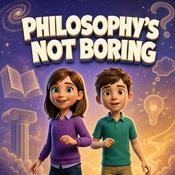 Kostenlos im App Store laden
radio.at
Sleeptimer
Sender speichern
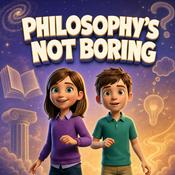
Philosophy for Kids / Philosophy's Not Boring: The Kids Philosophy Podcast
Kidopoly
Neueste Episode
126 Episoden
What is FOMO?
26.11.2026 | 10 Min.Have you ever felt a heavy pit in your stomach when you missed a fun birthday party or a trip to the park? That terrible feeling is called FOMO, or the Fear Of Missing Out! But why does our brain do this to us? Join Mira and Finn on Philosophy is Not Boring as they uncover the wild psychological secrets behind FOMO!
Did you know this anxious feeling actually comes from ancient cavemen? Thousands of years ago, early humans had to stick with their tribe to survive saber-toothed tigers, so being left out felt like real danger! Fast forward to 1954, and psychologist Leon Festinger discovered that we naturally compare ourselves to others like a built-in thermometer. We even learn about a Harvard student named Patrick McGinnis who actually invented the word "FOMO" in 2004!
But don't worry, you don't have to feel left out forever. Discover the amazing superpower of JOMO—the Joy Of Missing Out! Find out how putting on comfy pajamas and enjoying the present moment can turn that fear into total happiness. Tune in and learn how to master your own mind!What is cuteness?
25.11.2026 | 12 Min.Have you ever seen a wobbly puppy or a smiling human baby and felt an overwhelming urge to squeeze their chubby cheeks? You aren't just being nice—your brain is being mathematically hacked! In 1943, an animal researcher named Konrad Lorenz made an incredible discovery. He realized that human babies, puppies, and kittens all share the exact same physical traits: giant oversized heads, huge round eyes placed low on the face, and clumsy, wobbly movements! He named this scientific blueprint the "Kindchenschema," or baby schema.
But why does this matter? Evolutionary psychologists discovered that this is actually an ancient survival trick! When you see these specific "cute" features, your brain releases a feel-good chemical called dopamine. This evolutionary superpower acts like mind control, forcing grown-ups to protect, cuddle, and take care of vulnerable babies! Today, animators, toy designers, and cartoonists use these exact mathematical rules to create beloved characters (even Mickey Mouse was redesigned over time to fit the cuteness math!). Join Mira and Finn as they uncover the incredible, mind-controlling science behind why we love cute things!Who was Baruch Spinoza?
24.11.2026 | 11 Min.Have you ever wondered what love actually is? Is it a kind of magic, or is it a recipe you can learn? Step back in time to 17th-century Amsterdam to meet a brilliant philosopher named Baruch Spinoza! By day, Spinoza had the super cool job of grinding glass lenses for early microscopes and telescopes. But in his quiet room, he spent his time polishing amazing ideas to help humans see themselves more clearly!
Spinoza believed that our feelings weren't just random monsters that attack us, but things that make sense like math or science. In his famous book Ethics, he wrote a mind-blowing formula: love is simply joy caused by something outside of us! Whether it's your pet dog, a warm chocolate chip cookie, or a huge hug, they give you joy, and your mind naturally loves them for it!
But what about hate? Spinoza taught that hate shrinks our world and drains our battery. His amazing secret weapon to defeat it? Understanding! Discover how acting like a scientist with your emotions can help you turn away from anger, grow your love, and make the world a much brighter place!Who was Hypatia of Alexandria?
23.11.2026 | 10 Min.Have you ever wondered what it would take to be the most respected teacher in an entire ancient city? Meet Hypatia of Alexandria! Born over 1,600 years ago in Roman Egypt, Hypatia learned maths and astronomy from her father Theon, then outshone him to become the city's leading teacher, lecturing in public in a philosopher's cloak.
Students travelled from all over the Mediterranean to hear her teach that studying maths and the stars lifts your mind toward the truth. She even helped one of them, Synesius, design an astrolabe, a star-mapping instrument, and he loved her so much he called her his mother, his sister and his teacher.
Join Mira and Finn on Philosophy's Not Boring as they explore the life of one of history's greatest thinkers, and why the world still remembers her today.Why did humans create art?
22.11.2026 | 12 Min.Have you ever grabbed a box of crayons to draw a giant purple dragon wearing sunglasses? A dragon doesn't even exist, but you still wanted to bring it to life! But why? Why are humans the only creatures on Earth that make art just to share an idea? Other animals do things that look like art—like a clever bowerbird building a colorful, shiny stage or a peacock fanning its feathers—but they only do it to impress a mate!
In this colorful episode, Mira and Finn dive into the amazing mystery of human creativity! We'll travel back 40,000 years to dark caves in Indonesia where ancient humans blew red paint over their hands to leave a permanent mark on the walls. What were they trying to say?
We'll also meet famous philosophers to crack the code! Did you know ancient Greek thinker Aristotle believed we love to copy the world to safely practice our big emotions? Or that twentieth-century philosopher Susanne Langer thought art was a magical language of feeling? Join us to discover how every doodle on your fridge is actually a piece of your invisible mind made visible!
Weitere Bildung Podcasts







Trending Bildung Podcasts























Über Philosophy for Kids / Philosophy's Not Boring: The Kids Philosophy Podcast
A groundbreaking podcast for curious kids aged 4-12, and the grown-ups listening with them, that proves philosophy, psychology and religion are anything but dull.Join our fictional AI hosts Mira, a brilliant 9-year-old, and her younger brother Finn, age 7, as they explore philosophy, psychology and religion as one big family of questions about how we make sense of things. Each episode takes a real thinker or idea seriously, from what makes you the same person you were as a baby to why people across the world believe such different things about the soul, and then lands it somewhere in your actual life.We don't hand you the answer and move on. Some questions have one; some have several worth comparing; some nobody has ever settled, and we'll tell you which is which. On matters of faith we stay even-handed: we describe what people believe from the outside, and never tell you what to believe yourself. Because philosophy isn't a pile of hard words to memorize. It's learning to ask a better question, and to sit with it honestly, even when it's uncomfortable.A note on why we use AI. For us, AI allows us to deliver learning at a scale and quality that previously would have been too expensive. If we make the odd technical error, or the sound goes a bit funny, bear with us, we're trying our best. We hope you enjoy the show!
Podcast-WebsiteHöre Philosophy for Kids / Philosophy's Not Boring: The Kids Philosophy Podcast, {ungeskriptet} - Der Meinungsfreiheit verpflichtet. und viele andere Podcasts aus aller Welt mit der radio.at-App
Hol dir die kostenlose radio.at App
- Sender und Podcasts favorisieren
- Streamen via Wifi oder Bluetooth
- Unterstützt Carplay & Android Auto
- viele weitere App Funktionen
Philosophy for Kids / Philosophy's Not Boring: The Kids Philosophy Podcast: Zugehörige Podcasts
 Österreich