
Höre diesen Podcast kostenlos in der App: Kostenlos im App Store laden
radio.at
Sleeptimer
Sender speichern
52 Episoden
EP52: Mitch Rawlyk - Read The Land Before You Build On It
18.11.2026 | 46 Min."Information is only as good as your ability to put it to productive use."
— Bill Mollison, quoted by Mitch Rawlyk
For almost two years, Mitch and Maddie looked at the same property listing every Saturday morning. They had talked to the realtor and were planning the site visit. A week before it, Mitch ran the drainage layer: a flow accumulation line heading straight through the house.
That story is a tidy summary of everything Mitch has built. The data that could have saved a future homeowner from a flooded foundation — or worse — was always there, sitting in publicly available geospatial datasets. What was missing was any tool that made that data accessible to someone without a GIS degree, three hours of setup time, and a high tolerance for software that crashes without warning.
Mitch Rawlyk is a geomorphologist, applied meteorologist, and founder of LandScope — a land intelligence platform built to close that gap. The conversation was recorded outdoors on his grandfather's farm in Alberta, the same land where Mitch first noticed, as a child, that horsetail was growing in one spot and not another, and started asking why.
---
Mitch's academic path took him from an undergraduate in physical geography — geomorphology, hydrology, climatology — through a master's in applied meteorology at a university in New Zealand, where his thesis built a machine learning-based frost prediction model for vineyards. He became, in his own words, an Earth system scientist who understood how all the fragmented disciplines connected — and was frustrated that nobody was teaching those connections. His entry into the regenerative and permaculture world came through Rob Avis of Verge Permaculture, whom he contacted during the COVID lockdowns while teaching himself Python in his parents' basement. That combination — deep terrain science, software fluency, and a permaculture systems lens — eventually became LandScope.
The platform takes the geospatial data that has always existed — LiDAR-derived elevation models, drainage flow accumulations, slope aspects and angles, contour lines — and makes it usable in seconds. Draw an area, and within 45 seconds you have high-resolution terrain intelligence for 160 acres: where water wants to move, which slopes face south, where the flat ground actually is, and what lies outside your property boundary that might be heading toward it. Version 2 adds 3D visualisation, collaborative annotation, cross-section tools tied to actual LiDAR accuracy, and print outputs that do not make you want to close the laptop.
---
Learn more and connect:
1. LandScope — https://landscope.earth (free trial available on sign-up)
2. Mitch Rawlyk on LinkedIn — https://www.linkedin.com/in/mitchrawlyk
3. Mitch Rawlyk on Instagram — search @mitchrawlyk for field content and terrain storytelling
---
If this conversation opened something up for you, here are the resources to go further:
Discover more about regenerative design at Paulownia Landscape Architects: https://www.paulownia-la.com
Dive into the 12 Universal Laws of Nature and unlock the secrets of harmonizing with our planet at https://www.12lawsofnature.com
Fulfill your garden aspirations with expert guidance from the Garden of Your Dreams masterclass at https://www.gardenofyourdreams.com
Ready to take actionable steps towards your dream garden? Book a complimentary 30-minute session with Matthieu for immediate results: https://calendly.com/garden-of-your-dreamsEP51: Chris Gilmour - One Design, Every Disaster Solved
04.11.2026 | 1 Std. 3 Min."If something's sustainable, you actually need to be in relationship with the ecology of your region."
The idea that disaster preparedness and beautiful, productive land design are the same project sounds counterintuitive until someone walks you through it step by step. That is exactly what this episode does. Chris Gilmour has spent the last two decades working at an unusual crossroads: professional emergency and disaster management on one side, permaculture and wilderness ecology on the other. What he has found — and what this conversation makes vividly concrete — is that the frameworks that make a property resilient to disaster are the same frameworks that make it productive, beautiful, and low-maintenance. You are not choosing between a functional property and a thriving one. Designed well, they are the same property.
Matthieu and Chris move through real examples at every scale: a 26-acre homestead where cutting a stand of trees eliminated a structural hazard, stopped chronic rot, produced a year of firewood, stabilised sandy soil, and grew into a food forest and assisted-migration wildlife corridor — all in one design move. A Southern Ontario power grid where the wrong tree species growing under power lines has quietly created a catastrophic ice-storm risk for millions of people. An urban school where thorny native hedgerows replaced barbed wire fencing and clear sightlines replaced random layout — invisible preparedness that looks entirely like a garden. And a perennial polyculture on a front lawn that produces blueberries, honeyberries, elderberries, mushrooms, rhubarb, and squash on a few hours of tending per year. The episode is a masterclass in what it means to hold the ecological lens and the practical, financial, and resilience lenses simultaneously — and to refuse to give any of them up.
Chris Gilmour is a Canadian wilderness guide, survival instructor, permaculture practitioner, and certified emergency and disaster management consultant. He grew up as a suburban kid whose father took him into the backcountry on canoe trips, and has spent the decades since building a deep fluency in ecology, traditional plant knowledge, forestry, and professional emergency planning — working with municipalities, hospitals, hydro corporations, and private landowners alike. He runs a 26-acre permaculture homestead in Ontario, consults with individuals, organizations, businesses, and communities through his holistic emergency preparedness framework, and shares much of this thinking freely through his newsletter and YouTube channel. He is one of the rare practitioners who has genuinely integrated these two worlds rather than simply borrowing vocabulary from each.
Learn more and connect:
1. Chris Gilmour's website, newsletter, consulting, and online courses: https://www.chrisoutdoors.ca
2. YouTube channel — practical, short-form videos of these design concepts in the field: search "Chris Outdoors ON" on YouTube
Take the next step in designing land that works with nature and performs for your future:
Discover more about regenerative design at Paulownia Landscape Architects: https://www.paulownia-la.com
Dive into the 12 Universal Laws of Nature and unlock the secrets of harmonizing with our planet at https://www.12lawsofnature.com
Fulfill your garden aspirations with expert guidance from the Garden of Your Dreams masterclass at https://www.gardenofyourdreams.com
Ready to take actionable steps towards your dream garden? Book a complimentary 30-minute session with Matthieu for immediate results: https://calendly.com/garden-of-your-dreams
---EP50: Rick Rosenfield - The Culture That Built California Pizza Kitchen
21.10.2026 | 46 Min."If you care about people, if you're going to start a business — do it. But if you're a person that can't delegate, that can't trust people, that has a cynical view, wants to micromanage everything — I'd say don't do it."
There is a version of the business-culture conversation that has become so familiar it says almost nothing: mission statements, ping pong tables, buzzwords on a wall. And then there is the version Rick Rosenfield lived — four decades of building, selling, surviving, and occasionally watching others dismantle what he created — which turns out to be a very different story.
Rick co-founded California Pizza Kitchen in Beverly Hills in 1985 with his law partner Larry Flax. Neither had ever run a restaurant. What they did have was a clear sense of how they wanted to treat people — team members, customers, and each other — and the stubbornness to act on it even before they had language for what they were doing. The company they built grew into one of the most recognisable restaurant brands in America: hundreds of locations, a devoted following, and a culture that kept people loyal for 30 and 40 years at a stretch.
In this conversation, Rick traces the CPK origin story back to Alice Waters and the farm-to-table movement that started at Chez Panisse in Berkeley, explains how barbecue chicken pizza became the unlikely hook that launched a cultural phenomenon, and unpacks the four-word framework — ROCK: Respect, Opportunity, Communication, Kindness — that eventually codified what they had been doing by instinct from day one. He speaks with equal honesty about the hard parts: over-expansion under PepsiCo, the pain of laying off people he cared about, and watching private equity strip quality from a brand he had built by hand.
The conversation also moves into territory that connects directly to Matthieu's work — the grassroots nature of genuine movements, why political framing of environmental issues gets nothing done, regenerative hospitality, and what Larry Ellison is building on the island of Lanai: a self-sufficient ecosystem anchored in regenerative farming, wellness, and guided land stewardship. For anyone thinking about how to build something that lasts, scales, and still means something, Rick's forty-one years of experience is a rare and honest guide.
---
Learn more and connect:
1. Rick Rosenfield's website (book, contact, signed copies): https://www.rickrosenfield.com
2. The California Pizza Kitchen Story on Amazon: https://www.amazon.com
3. Rick Rosenfield on LinkedIn: https://www.linkedin.com/in/rick-rosenfield
4. Sensei Retreats — Larry Ellison's regenerative wellness concept on Lanai: https://www.senseiretreats.com
5. Pineapple Brothers — guided hunting and land stewardship on Lanai: https://www.pineapplebrothers.com
---
Discover more resources to take your thinking further in regenerative design and business:
Discover more about regenerative design at Paulownia Landscape Architects: https://www.paulownia-la.com
Dive into the 12 Universal Laws of Nature and unlock the secrets of harmonizing with our planet at https://www.12lawsofnature.com
Fulfill your garden aspirations with expert guidance from the Garden of Your Dreams masterclass at https://www.gardenofyourdreams.com
Ready to take actionable steps towards your dream garden? Book a complimentary 30-minute session with Matthieu for immediate results: https://calendly.com/garden-of-your-dreams
---EP49: Erwan Le Corre - Your Body Is A Soil
01.10.2026 | 52 Min."The nervous system is not just regulated, it's recalibrated — means it gets its baseline shifts to something more robust, that's more emotionally resilient. It takes way more for you to be feeling startled, upset."
If regenerating degraded land means restoring its capacity to produce life, what would it mean to apply the same logic to the human body? That is the thread running through this conversation with Erwan Le Corre — a thinker and practitioner who has spent over two decades arguing that the way modern life treats the body is structurally identical to the way industrial agriculture treats soil: extractive, monotonous, cut off from the conditions it actually needs to thrive. The parallels he draws are not metaphorical gestures. They are precise, biological, and actionable. And his method for addressing the problem — through natural movement and deliberate breath holding — runs directly against the prevailing current of a wellness industry built on reducing stress rather than building the capacity to handle it.
Erwan Le Corre is the founder of MovNat, the practice of natural human movement that he effectively created as a named, teachable discipline over twenty years ago. Before MovNat existed as a method, the full spectrum of human movement abilities — climbing, jumping, balancing, carrying, crawling, swimming — had been fragmented into specialised sports or simply forgotten as a dimension of fitness. Le Corre reassembled them into a unified practice now taught by certified coaches around the world. More recently, he has developed Breath Hold Work, a method that uses breath retention not to calm the nervous system but to recalibrate it — training the mind to generate patience, clarity, and emotional stability under the specific stress of oxygen deprivation, with the result that those qualities become structurally embedded, not just temporarily available. He holds the US national record in static apnea and is currently writing three books, including one on the physiology, history, and mind-training applications of breath holding.
Learn more and connect:
1. MovNat — natural movement method and certified coaching worldwide: https://www.movnat.com
2. Breath Hold Work — Erwan Le Corre's breath holding and mind training practice: https://www.breathholdwork.com
---
Explore these resources to go further with regenerative design and natural living:
Discover more about regenerative design at Paulownia Landscape Architects: https://www.paulownia-la.com
Dive into the 12 Universal Laws of Nature and unlock the secrets of harmonizing with our planet at https://www.12lawsofnature.com
Fulfill your garden aspirations with expert guidance from the Garden of Your Dreams masterclass at https://www.gardenofyourdreams.com
Ready to take actionable steps towards your dream garden? Book a complimentary 30-minute session with Matthieu for immediate results: https://calendly.com/garden-of-your-dreams
---EP48: Nadia Riley - The Animal Architect Redesigning Human Space
09.09.2026 | 1 Std. 3 Min."If the zoos would be unpaid, we could use them as actually wellness centers, as regenerative centers, as psychological centers. We could do sports, we could do picnics, we could do community stuff and still enjoy the animals and connect to the animals as to an animal and not a commodity which I paid for."
There is a field of design science called neuroarchitecture, and it has been quietly documenting something most of us half-know but have never been able to name: that the spaces we live and work in are not neutral. Our brains — operating on wiring that predates cities, screens, and open-plan offices by tens of thousands of years — are constantly reading every built environment we enter for signals of safety, threat, and belonging. The design choices we make, often for reasons of trend or cost or aesthetic fashion, are landing in an ancient nervous system that was not consulted when those choices were made. The results are measurable, and often uncomfortable.
Nadia Riley came to this field from an unexpected angle. She is an animal architect — perhaps the only practicing architect in the world whose entire professional focus is the design of environments for non-human animals. She trained in architecture, redirected her degree towards the design of veterinary facilities and quarantine centers for wildlife, built a practice that took her from rhino sanctuaries in South Africa to animal facilities across the Emirates and beyond, and then, after a genuine professional and personal crisis that she describes with candour and precision, rebuilt that practice on a deeper foundation. The field of neuroarchitecture, which had been developed in the context of human spaces, gave her new tools to ask more rigorous questions about what animal habitats actually require — not just in terms of welfare regulations and square metres, but in terms of the sensory and biological needs of the animals themselves.
What emerges in this conversation is a way of thinking about designed space that cuts across the animal-human boundary. The same principles that explain why high-gloss bathroom tiles increase stress and why open-plan offices undermine productivity also explain why so many zoo habitats fail the animals inside them. And the same corrective — designing from the inside out, from the lived experience of the being who will inhabit the space, rather than from aesthetic trend or institutional convenience — applies equally to a gorilla enclosure and a human home.
Learn more and connect:
1. Animal Space Design (Nadia Riley's practice, portfolio, and free downloadable articles) — https://www.animalspacedesign.com
2. Free resources and PDFs on animal architecture tools and methods — available at the free downloadables section of https://www.animalspacedesign.com
3. Connect with Nadia Riley on LinkedIn — https://www.linkedin.com/in/hazkoba-nadia-riley-architecture-animals/
Take your understanding of regenerative design further with these resources:
Discover more about regenerative design at Paulownia Landscape Architects: https://www.paulownia-la.com
Dive into the 12 Universal Laws of Nature and unlock the secrets of harmonizing with our planet at https://www.12lawsofnature.com
Fulfill your garden aspirations with expert guidance from the Garden of Your Dreams masterclass at https://www.gardenofyourdreams.com
Ready to take actionable steps towards your dream garden? Book a complimentary 30-minute session with Matthieu for immediate results: https://calendly.com/garden-of-your-dreams
Weitere Firmengründung Podcasts







Trending Firmengründung Podcasts






Über The Regenerative Design Podcast™
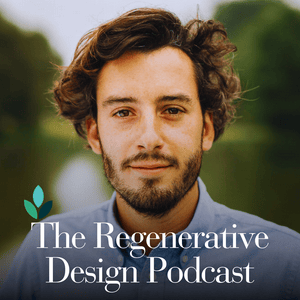
This is the Regenerative Design Podcast with your host Matthieu Mehuys. In this show we interview the leading authorities in the world of regenerative practices, people who do well and do good.
Podcast-WebsiteHöre The Regenerative Design Podcast™, The Prof G Pod with Scott Galloway und viele andere Podcasts aus aller Welt mit der radio.at-App
Hol dir die kostenlose radio.at App
- Sender und Podcasts favorisieren
- Streamen via Wifi oder Bluetooth
- Unterstützt Carplay & Android Auto
- viele weitere App Funktionen

The Regenerative Design Podcast™: Zugehörige Podcasts
 Österreich

