

Höre diesen Podcast kostenlos in der App: Kostenlos im App Store laden
radio.at
Sleeptimer
Sender speichern
393 Episoden
Tongue Ties Revisited: Why Not All Ties Need Release
11.10.2026 | 18 Min.In a digital age where social media posts and quick photos often drive clinical discussions, it is easy to mistake an anatomic tether for a definitive diagnosis. However, looking at a static picture of a lingual frenulum tells you almost nothing about how that tongue functions in real time during feeding, speech, or sleep.
In this solo masterclass, Hallie Bulkin revisits the nuanced and evolving landscape of pediatric tethered oral tissues (TOTS). She breaks down why clinical decision-making must always prioritize functional limitations over visual appearances.
Hallie explores how children build compensation strategies, when those compensations become exhausting or harmful, and how restricted tongue mobility interacts with underlying airway and sleep architecture. She also outlines a child-centered framework for pre- and post-release therapy, informed consent, and knowing when a surgical referral is truly warranted.
Key Topics & Takeaways
Anatomy vs. Function: Why a photograph or visual inspection alone can never determine whether a tongue tie requires surgical release.
Evaluating Compensations: Identifying when a child's compensatory movements are masking deeper motor fatigue, inefficient feeding, or speech breakdown.
Airway & Sleep Interplay: Understanding how restricted lingual mobility coexists with mouth breathing, high-arched palates, and compromised sleep quality.
The Clinical Reasoning Checklist: Asking what isn't functioning, what evidence exists, and whether targeted therapy alone can achieve functional goals.
Soundbites
"You haven't seen how the tongue moves if you're only looking at a picture - function always trumps anatomy."
"True clinical confidence isn't knowing how to spot a tie; it's understanding what the patient actually needs to function efficiently."
"Ask yourself: what isn't functioning, what evidence do you have, and how does this affect the child's whole system?"
Timestamps
00:00 – Reflection on Episode 184 and Evolving Clinical Reasoning
00:37 – Introduction to The Untethered Podcast
01:14 – Shifting the Focus: Assessing Function over Anatomy
01:46 – Moving Beyond the "Tongue Tie Debates" and Binary Mindsets
02:23 – Defining Ankyloglossia (Tongue Tie) vs. Tissue Appearance
03:41 – The "Function, Form, Impact, Decision" Framework
04:00 – Evaluating Tongue Mobility and Function
04:50 – Analyzing Compensatory Strategies in Patients
05:33 – Assessing Functional Impact on Feeding and Speech
07:18 – Airway Considerations and Coexisting Factors
08:38 – The Connection Between Speech Sound Disorders and Tongue Ties
09:30 – Recognizing When Therapy Progress Hits an Anatomical Ceiling
10:35 – Effective Interprofessional Collaboration and Referral Workflows
11:53 – Pre- and Post-Release Rehabilitation Care
12:33 – Individualized Care vs. Standardized Protocols (Infant & Pediatric Considerations)
14:34 – Putting the Patient (Not the Tissue) at the Center of Care
14:51 – Practical Key Questions to Ask in Your Clinical Practice
16:44 – The Ultimate Goal of Integrated Clinical Reasoning
17:16 – Tongue Tie Boot Camp & Ep. 184 Listener Challenge
18:12 – Outro & Legal Disclaimer
Links & Resources
Become the Pediatric Feeding Therapist Who Knows Exactly What to Do With Every Child https://www.feedthepeds.com/.
WORTH A LISTEN: CONTINUE YOUR JOURNEY
Episode 184: Not All Ties Need to be Released.
Why Some Cases Stay Stuck: The Clinical Thinking That Changes Outcomes.
STAY CONNECTED
💬 Join the Conversation: Connect with Hallie for weekly clinical takeaways, case study breakdowns, and program updates on Instagram | Facebook | LinkedIn.
If Hallie's insights on functional assessment and clinical reasoning gave you a fresh perspective on tethered oral tissues, please take a quick moment to leave a review! Your support helps us share these vital clinical frameworks with therapists everywhere.
Hosted on Acast. See acast.com/privacy for more information.What I Was Missing in Feeding Therapy: ARFID, Airway, and Myo with Samy Hernandez
04.10.2026 | 46 Min.When pediatric therapists treat feeding and speech in isolation, critical underlying root causes are easily overlooked. From jaw instability and retained primitive reflexes to phonological processes that are actually unaddressed motor speech deficits, true clinical progress requires an integrated, whole-system framework.
In this episode, Hallie Bulkin welcomes back returning guest Samy Hernandez, M.S., CCC-SLP, TSSLD, ASDCS, CPFT™, a pediatric speech-language pathologist at B Well Tots. Samy reflects on her clinical evolution since becoming one of the very first Certified Pediatric Feeding Therapists™ and making the pivotal decision to integrate Orofacial Myofunctional Therapy (OMT) and Oral Placement Therapy (OPT) directly into her practice.
About the Guest: Samy Hernandez, CCC-SLP, ASDCS, CPFT™
Samy Hernandez is a licensed and certified Speech-Language Pathologist, Certified Autism Spectrum Disorder Clinical Specialist (ASDCS), and Certified Pediatric Feeding Therapist™ (CPFT™) at B Well Tots, where she provides neurodiversity-affirming, child-led therapy built through trust, play, and curiosity.
Key Topics & Takeaways
Two Sides of the Same Coin: Why pediatric feeding therapy and myofunctional therapy (OMT) cannot be separated when treating complex oral-motor and airway challenges.
How OPT & OMT Enhance Practice: Integrating Oral Placement Therapy (OPT) and myofunctional tools to strengthen diagnostic precision and treatment outcomes.
Rethinking Speech Sound Hierarchies: Questioning traditional phonological processes and exploring how motor speech hierarchies provide a clearer roadmap for children with PFD and OMD.
Interdisciplinary Team Care: Structuring seamless collaboration between SLPs, OTs, ENTs, and bodyworkers working toward shared goals for the same child.
Soundbites
"Pediatric feeding therapy and myofunctional therapy were never two separate things - they are two sides of the same coin."
"When you evaluate speech through a motor speech hierarchy, you realize how many 'phonological processes' are actually unaddressed jaw instability."
Timestamps
01:25 – Guest Introduction: Hallie Bulkin introduces speech-language pathologist Samy Hernandez.
02:14 – Clinical Practice Updates: Samy Hernandez shares updates on moving to Philadelphia and incorporating myo therapy into her daily practice.
05:00 – Airway & ARFID: Samy Hernandez and Hallie Bulkin discuss addressing root airway issues before treating feeding disorders.
16:50 – Motor vs. Phonology: Hallie Bulkin and Samy Hernandez explore how speech errors often stem from motor constraints rather than phonological processes.
26:03 – Jaw Stability & Speech: Samy Hernandez and Hallie Bulkin detail how jaw grading directly impacts speech sounds like /r/.
34:47 – Neurodiversity-Affirming Myo: Samy Hernandez explains adapting myofunctional therapy for autistic children using sensory movement and play.
Links & Resources
Connect with Samy Hernandez on Instagram @happyhandsSLP : Book an appointment, explore clinical services, and view practice resources at B Well Tots.
Become the Pediatric Feeding Therapist Who Knows Exactly What to Do With Every Child https://www.feedthepeds.com/.
WORTH A LISTEN: CONTINUE YOUR JOURNEY
Seeing It vs. Understanding It: The Gap in Myo Training.
Why Some Cases Stay Stuck: The Clinical Thinking That Changes Outcomes.
STAY CONNECTED
💬 Join the Conversation: Connect with Samy on Instagram @happyhandsSLP or at B Well Tots and follow Hallie for weekly clinical takeaways, case study breakdowns, and program updates on s on Instagram | Facebook | LinkedIn.
If Samy's insights on jaw grading, motor speech hierarchies, primitive reflexes, and neurodiversity-affirming care broadened your clinical perspective, please take a quick moment to leave a review! Your support helps us share these vital clinical conversations with therapists everywhere.
Hosted on Acast. See acast.com/privacy for more information.92507 Is Ending: How to Bill Speech and Feeding Together with 92526 in 2027
27.09.2026 | 16 Min.Navigating healthcare billing is about to undergo a massive structural shift. For speech-language pathologists, feeding therapists, and private practice owners, the sunsetting of long-standing core CPT codes requires proactive preparation, documentation adjustments, and clear system updates.
In this episode, Hallie Bulkin unpacks the upcoming 2027 CPT code overhaul for speech and feeding therapy services. Most notably, standard CPT code 92507 will be replaced by five distinct, specialized codes covering fluency, speech sounds, language, combined speech and language, and voice upper airway dysfunction.
Hallie breaks down how to report multiple services provided on the same day, navigate payer-specific policies, apply modifier 59 correctly, and utilize time-based add-on codes using midpoint timing rules. She also discusses the business and clinical importance of building internal feeding therapy expertise to optimize patient care and ensure long-term practice sustainability.
Key Topics & Takeaways
The Replacement of CPT 92507: Preparing for 2027, where 92507 will split into five targeted codes for fluency, speech sound disorders, language, combined speech-language, and voice/upper airway dysfunction.
Same-Day Multiple Service Reporting: Understanding how to accurately report distinct clinical services on the same date of service without triggering claim denials or unbundling errors.
Applying Modifiers & Timing Rules: Utilizing modifier 59 effectively and calculating session midpoints for time-based add-on codes to secure appropriate reimbursement.
Navigating Payer Reductions: Managing payment adjustments, commercial insurance policies, and Medicare guidelines when billing multiple codes per session.
Building Internal Feeding Skills: Expanding internal clinical skill sets to keep pediatric feeding care in-house, reducing unnecessary external referrals while growing practice offerings.
Soundbites
"CPT code 92507 will be replaced by five distinct, specialized codes in 2027—preparing your documentation systems now is essential for practice compliance."
"Timing rules and session midpoints dictate when add-on codes can be reported to support accurate, defensible reimbursement."
"Understanding payer-specific policies and modifier applications allows you to protect your practice against underbilling or accidental unbundling."
Timestamps
00:00 — Introduction: Reporting Speech and Feeding Together
00:26 — Welcome to The Untethered Podcast & Oral Rest Posture Reminder
01:02 — Upcoming CPT Code Changes: Goodbye 92507, Hello 10 New Codes for 2027
02:21 — Code Bundling vs. Reporting Distinct Services on the Same Day
03:06 — Current Billing Landscape: Speech (92507) and Swallowing/Feeding (92526)
04:28 — 2027 Session Examples: Midpoint Timing Rules with Speech and Feeding
07:06 — Comparing Combined Speech-Language Codes vs. Separate Treatment (Speech Sounds & Voice)
11:56 — Expanding Pediatric Feeding Services in Your Practice & Team Mentorship
14:27 — Free 3-Day Training Announcement: "Screen the Peds to Feed the Peds"
15:43 — Episode Disclaimer, Review Call to Action, and Outro
Links & Resources
FREE TRAINING: Screen The Peds to Feed The Peds Training.
WORTH A LISTEN: CONTINUE YOUR JOURNEY
What Myofunctional and Feeding Therapists Need to Know About Scope, Coding, and Documentation (Ep 386).
Screening vs. Assessment vs. Treatment: Why Every Clinician Needs to Know the Difference (Ep 380).
STAY CONNECTED
💬 Join the Conversation: Connect with Hallie for weekly clinical takeaways, case study breakdowns, and program updates on s on Instagram | Facebook | LinkedIn.
If this episode helped clarify the upcoming CPT code changes and billing rules for your practice, please take a quick moment to leave a review! Your support helps us share these vital business and clinical insights with therapists everywhere.
Hosted on Acast. See acast.com/privacy for more information.Oral Motor and Airway Red Flags in the First Two Years with Mackenzie Shiba
20.09.2026 | 57 Min.When a baby struggles with infant feeding, weight gain, or subtle airway restrictions, parents are frequently told to "wait and see." Yet, waiting often turns minor early red flags into complex speech, feeding, and oral-motor challenges down the road.
In this episode, Hallie Bulkin sits down with Mackenzie Shiba, M.S., CCC-SLP, CMT®, pediatric speech-language pathologist, certified myofunctional therapist, and founder of Communication Blooms Speech Therapy. Mackenzie shares her personal transition from clinician to a late-night searching parent when her own son faced unexpected feeding and growth struggles. That journey revealed a critical gap in early pediatric guidance and inspired her to build The Blooms Blueprint - a comprehensive roadmap for parents spanning six age windows from birth to age two.
Together, Hallie and Mackenzie discuss why "the mouth that eats is the mouth that talks", how to differentiate between common infant behaviors and true structural airway red flags, and why a parent's gut instinct is valid clinical data. They unpack actionable strategies for empowering caregivers, facilitating early interdisciplinary care, and shifting from reactive diagnoses to proactive developmental support.
Key Topics & Takeaways
The 2 AM Googler Reality: How personal experience with infant feeding and growth struggles drives the need for clear, proactive parental guidance.
Retiring "Wait and See": Shifting the clinical and pediatric culture from passive waiting to active, supportive observation and early action.
The Interconnected Mouth: Understanding why feeding, oral-motor function, airway patency, and early speech are fundamentally linked ("the mouth that eats is the mouth that talks").
The Blooms Blueprint Framework: Breaking down six key developmental windows from birth to age two to help families spot small red flags early.
Soundbites
"We need to retire 'wait and see' because it leaves worried parents sitting at home carrying that heavy burden alone."
"The mouth that eats is the mouth that talks—feeding, airway, oral motor, and early speech development are completely interconnected."
"Airway is the conversation nobody is having with new parents, but common isn't the same as fine."
Timestamps
01:16 Guest Introduction: Mackenzie Shiba, M.S., CCC-SLP, CMT®
02:16 From Clinician to 2 AM Googler: Mackenzie's Personal Journey
05:44 Shared Experiences: Navigating Low Percentiles, Triple Feeding & System Gaps
12:44 Having Non-Alarmist Airway Conversations with Parents
25:00 Root Causes of Speech Patterns: Motor Patterns vs. Phonological Processes
27:00 Hidden Red Flags: Maternal Oversupply & Missed Airway Signals
38:08 Practical Action Steps: 1-Minute Daily Hacks for Caregivers
43:03 How Myofunctional Therapy Shifts Clinical Practice
47:40 Clinicians as Community Leaders: Disrupting the Status Quo
55:24 Where to Connect with Mackenzie Shiba & Access The Blooms Blueprint
Links & Resources
Connect with Mackenzie Shiba: Explore resources and follow Mackenzie on Instagram @thebloomsblueprint and @communicationblooms.
Access The Blooms Blueprint: Get the guide for infant and toddler developmental milestones at The Blooms Blueprint Guide.
FREE TRAINING: Learn how structural airway limits directly affect feeding in our free Screen The Peds to Feed The Peds Training.
WORTH A LISTEN: CONTINUE YOUR JOURNEY
Why Some Cases Stay Stuck: The Clinical Thinking That Changes Outcomes.
Mouth Breathing vs. Nasal Breathing: Changing Lives Through Early Airway Intervention.
STAY CONNECTED
💬 Join the Conversation: Connect with Mackenzie on Instagram @thebloomsblueprint and follow Hallie for weekly clinical takeaways, case study breakdowns, and program updates on s on Instagram | Facebook | LinkedIn.
If Mackenzie's proactive approach to infant feeding and airway health empowered your clinical practice or parenting journey, please take a moment to leave a review! Your support helps us share these vital early intervention frameworks with families and providers everywhere.
Hosted on Acast. See acast.com/privacy for more information.Kids Are Not Small Adults: Why Pediatric Feeding Isn't Adult Dysphagia Scaled Down
13.09.2026 | 16 Min.One of the biggest hurdles clinicians face when transitioning into pediatric feeding therapy is realizing that traditional graduate coursework and isolated weekend seminars often leave massive gaps in clinical application. Too many training programs treat pediatric feeding as if it were simply adult dysphagia scaled down—focusing strictly on oral-motor mechanics while ignoring the child's entire developing system.
In this episode, Hallie Bulkin dives into the structural gaps of traditional feeding education and explains why treating a child requires an integrated, whole-system lens. She breaks down real-world case examples to demonstrate how behaviors like extreme texture selectivity or mealtime refusal are frequently symptoms of underlying postural instability, airway restriction, or sensory overload.
Hallie offers practical strategies to help clinicians move away from single-lens troubleshooting and develop the deep clinical reasoning required to connect isolated observations, uncover root causes, and create transformative intervention plans.
Key Topics & Takeaways
Pediatric vs. Adult Dysphagia: Why pediatric feeding cannot be treated as scaled-down adult management and requires a developmental, whole-body framework.
The Training Gap: Unpacking why standard feeding courses teach disconnected techniques rather than showing clinicians how to synthesize complex data.
Systemic Interconnectedness: Understanding how posture, airway, sensory processing, and nervous system regulation directly dictate oral-motor performance.
Redefining Clinical Reasoning: Shifting from "What exercise fixes this behavior?" to "What is this behavior telling me about the child's underlying system?"
Root-Cause Assessment: Transitioning away from symptom chasing to evaluate foundational barriers and build defensible, effective treatment plans.
Soundbites
"Pediatric feeding isn't adult dysphagia scaled down—it is a complex, dynamic, developmental system."
"Traditional training teaches isolated pieces of the puzzle, but rarely shows clinicians how to connect them at the evaluation table."
"Effective feeding therapy requires us to look at the child's whole system. Symptoms are just clues pointing us toward the underlying root cause."
Timestamps
00:00 - Is What You See the Actual Problem?
00:44 - Welcome to The Untethered Podcast
01:20 - Why Grad School Didn't Prepare Us for Pediatric Feeding
02:26 - When 12 Complex Feeding Cases Land on Your Case Load
03:50 - Pediatric Feeding vs. Adult Dysphagia: A Different Operating System
05:00 - The Gap in Training & Connecting the Dots
06:41 - Case Example: Is It Sensory Refusal or Motor Difficulty?
08:24 - Looking Beyond Behavior to Find the Underlying Cause
09:03 - Avoiding "Hammer Lenses" (Airway, Sensory, & Motor Silos)
10:13 - Being Licensed Doesn't Magically Create Competency
11:27 - Why Continuing Education Alone Isn't Enough
13:13 - Developing True Clinical Reasoning
13:41 - Screen the Peds to Feed the Peds (Free 3-Day Training)
15:10 - Actionable Challenge for Your Hardest Case
16:16 - Episode Disclaimer & Outro
Links & Resources
FREE TRAINING: Learn how structural airway limits directly affect feeding in our free Screen The Peds to Feed The Peds Training.
WORTH A LISTEN: CONTINUE YOUR JOURNEY
Why Some Cases Stay Stuck: The Clinical Thinking That Changes Outcomes.
Screening vs. Assessment vs. Treatment: Why Every Clinician Needs to Know the Difference.
STAY CONNECTED
💬 Join the Conversation: Connect with Hallie for weekly clinical takeaways, case study breakdowns, and program updates on s on Instagram | Facebook | LinkedIn.
If Hallie's perspective on pediatric feeding education and clinical reasoning gave you a fresh lens for your practice, please take a moment to leave a review! Your support helps us share these vital clinical frameworks with therapists everywhere.
Hosted on Acast. See acast.com/privacy for more information.
Weitere Bildung Podcasts








Trending Bildung Podcasts









Über The Untethered Podcast™
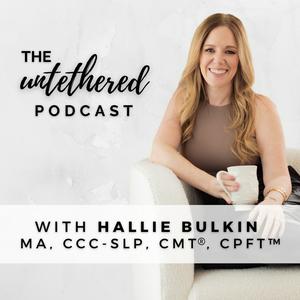
Hosted by Hallie Bulkin, a Certified Myofunctional Therapist™ (CMT®), Feeding Specialist and Speech Therapist, The Untethered Podcast™ focuses on the latest research and clinical evidence in Myofunctional Therapy, Tethered Oral Tissues (TOTs, AKA Tongue Tie, etc), Airway and Pediatric Feeding. Produced with both providers and parents in mind, episodes include interviews with experts, personal stories from parents, and Q&A from our listeners. Hosted on Acast. See acast.com/privacy for more information.
Podcast-WebsiteHöre The Untethered Podcast™, The Mel Robbins Podcast und viele andere Podcasts aus aller Welt mit der radio.at-App
Hol dir die kostenlose radio.at App
- Sender und Podcasts favorisieren
- Streamen via Wifi oder Bluetooth
- Unterstützt Carplay & Android Auto
- viele weitere App Funktionen
Hol dir die kostenlose radio.at App
- Sender und Podcasts favorisieren
- Streamen via Wifi oder Bluetooth
- Unterstützt Carplay & Android Auto
- viele weitere App Funktionen
The Untethered Podcast™
Code scannen,
App laden,
loshören.
App laden,
loshören.
The Untethered Podcast™: Zugehörige Podcasts
 Österreich