

Höre diesen Podcast kostenlos in der App: Kostenlos im App Store laden
radio.at
Sleeptimer
Sender speichern
21 Episoden
An Interview with Carsten Jahnke
27.11.2023 | 39 Min.Professor Carsten Jahnke, one of the leading historians on the Hanse has kindly granted us an interview where we discuss how the Hanse network functioned and how the perception of the Hanse has changed dramatically over the last 200 years, a story that almost as interesting as the history of the Hanse itself.
As listeners of the last season of the History of the Germans might have noticed, I have been relying heavily extensively on Carsten Jahnke's work. many of the episodes discussing the economic structure and the way money transfers worked in the network are based on his research. So if you liked those episodes, you will certanly enjoy this interview. Listen in!
And here are some links to research Carsten recommends for those of you who want to follow up further:
Christian Manger,
Behind the scenes: Urban secretaries as managers of legal and diplomatic conflicts in the Baltic region, c.1470–1540:
https://www.tandfonline.com/doi/full/10.1080/03044181.2022.2098528
Carsten Jahnke,
Von Mandeln, Narde, Curcuma und Kümmel. Herkunft, Handel und Verbrauch von „exotischen“ Gewürzen und Lebensmitteln im nördlichen Europa, in: Die Ausgrabungen im Lübecker Gründungsviertel II. Archäoparasitologie, Handelsgeschichte, Paläopathologie und Anthropologie, ed. by Dirk Rieger, Lübeck 2022, s. 131-164
Carsten Jahnke,
Hansische Kaufleute und deren Religiosität ausserhalb ihrer Heimat, i: Zapiski Historyczne, Tom LXXXIV, Rok 2019, Zeszyt 1, s. 7-41.
There is also a lecture Cartsen gave at the German Historical institute in London on teh perception history:
https://www.ghil.ac.uk/publications/podcasts/the-hanseatic-league-as-a-national-project
The music for the show is Flute Sonata in E-flat major, H.545 by Carl Phillip Emmanuel Bach (or some claim it as BWV 1031 Johann Sebastian Bach) performed and arranged by Michel Rondeau under Common Creative Licence 3.0.
As always:
Homepage with maps, photos, transcripts and blog: www.historyofthegermans.com
Facebook: @HOTGPod
Twitter: @germanshistory
Instagram: history_of_the_germans
Reddit: u/historyofthegermans
Patreon: https://www.patreon.com/HistoryofthegermansEpisode 19 - The Art and Culture of the Hanse
03.11.2023 | 25 Min.Our history of the Hanse has come to an end, not with a bang but with a whimper. Of the things that have remained we have already talked a lot, the ideal of the honourable Hanseatic merchant, the cultural and political links to Scandinavia and the stories. The stories of the famous pirates, Klaus Störtebecker and Hans Benecke, the heroics of the wars fought with Denmark and the antics of Jurgen Wullenwever.
But there is something that reminds us of the days when traders speaking low German fed Europe fish, beer and grain. And that are the cultural achievements, the town halls, weighing houses and stores that became symbols of civic pride, the artists whose works adorn churches and palaces across the Baltic sea and last but not least the brick churches that shaped the way these cities still appear..…let’s have a look.
And since podcasting is a most unsuitable medium to talk about visual art, I have added a few images to the episode webpage which you can find at Episode 127 - Art & Culture of the Hanse • History of the Germans Podcast
The music for the show is Flute Sonata in E-flat major, H.545 by Carl Phillip Emmanuel Bach (or some claim it as BWV 1031 Johann Sebastian Bach) performed and arranged by Michel Rondeau under Common Creative Licence 3.0.
As always:
Homepage with maps, photos, transcripts and blog: www.historyofthegermans.com
Facebook: @HOTGPod
Twitter: @germanshistory
Instagram: history_of_the_germans
Reddit: u/historyofthegermans
Patreon: https://www.patreon.com/HistoryofthegermansEpisode 18 - A Brief History of Bremen
27.10.2023 | 33 Min.Bremen was geographically and politically quite different from the other cities, ploughing its own furrow. In response the other Hansards did not trust the citizens of Bremen. There is also the minor issue that Bremen sheltered a lot of pirates. Still as the Hanse declined politically, Bremen took on an ever-larger role until becoming one of the last three Hanseatic Cities that kept that long-dead medieval relic plodding along until the late 19th century.
A story of rebellion, stubbornness, piracy and emigration to America, I thought worth telling.
The music for the show is Flute Sonata in E-flat major, H.545 by Carl Phillip Emmanuel Bach (or some claim it as BWV 1031 Johann Sebastian Bach) performed and arranged by Michel Rondeau under Common Creative Licence 3.0.
As always:
Homepage with maps, photos, transcripts and blog: www.historyofthegermans.com
Facebook: @HOTGPod
Twitter: @germanshistory
Instagram: history_of_the_germans
Reddit: u/historyofthegermans
Patreon: https://www.patreon.com/HistoryofthegermansEpisode 17 – The Rise of Hamburg
20.10.2023 | 34 Min.The last two episodes may have left you with a sense of gloom and foreboding about the great Hanseatic cities. But here is the counterintuitive fact, the Hanse may continuously loose political power and economic relevance, but the cities that make up the association are flourishing. Not all of them but some, Hamburg and Danzig in particular.
Why it is that the Hanse declines, but the Hansards are doing mightily well is what we are looking into this week. So let’s see….
The music for the show is Flute Sonata in E-flat major, H.545 by Carl Phillip Emmanuel Bach (or some claim it as BWV 1031 Johann Sebastian Bach) performed and arranged by Michel Rondeau under Common Creative Licence 3.0.
As always:
Homepage with maps, photos, transcripts and blog: www.historyofthegermans.com
Facebook: @HOTGPod
Twitter: @germanshistory
Instagram: history_of_the_germans
Reddit: u/historyofthegermans
Patreon: https://www.patreon.com/Historyofthegermans
Bibliography:
J.K. Dunlop, Hamburg 800-1945, Published by the Anglo-German Club E.V.
Philippe Dollinger, Die Hanse, 6. Auflage, 2012Episode 16 - Decline and Fall (Part 2)
13.10.2023 | 41 Min.1531-1535, a period of just 4 years is enough to capsize Lübeck’s position as the diplomatic heart of the Baltic Sea, general secretary of the Hanse, ally of both the king of Denmark and the king of Sweden and early member of the Schmalkaldic League. How can that happen?
As Edward Gibbon would say: History, in fact, is no more than a list of crimes of humanity, human follies and accidents”.
The music for the show is Flute Sonata in E-flat major, H.545 by Carl Phillip Emmanuel Bach (or some claim it as BWV 1031 Johann Sebastian Bach) performed and arranged by Michel Rondeau under Common Creative Licence 3.0.
As always:
Homepage with maps, photos, transcripts and blog: www.historyofthegermans.com
Facebook: @HOTGPod
Twitter: @germanshistory
Instagram: history_of_the_germans
Reddit: u/historyofthegermans
Patreon: https://www.patreon.com/Historyofthegermans
Bibliography:
Rainer Postel: Der Niedergang der Hanse
in Hanse, Lebenswirklichkeit und Mythos: RI
OPAC (regesta-imperii.de)
Jahnke, Carsten: Die Hanse | Reclam Verlag
Philipp Dollinger: Die Hanse
Weitere Bildung Podcasts
 Hörsaal - Deutschlandfunk NovaBildung
 Erklär mir die WeltBildung
 Quarks Science CopsBildung
 Wissen mit JohnnyBildung
 Hopf & KettnerBildung
 Eine Stunde History - Deutschlandfunk NovaBildung
 Einschlafen mit WikipediaBildung, Gesellschaft und Kultur, Gesundheit und Fitness
 Die Köpfe der Genies mit Maxim MankevichBildung, Religion und Spiritualität, Selbstverwirklichung, Spiritualität
 {ungeskriptet} - Der Meinungsfreiheit verpflichtet.Bildung, Gesellschaft und Kultur, Selbstverwirklichung
 The Mel Robbins PodcastBeziehungen, Bildung, Gesellschaft und Kultur, Gesundheit und Fitness, Mentale Gesundheit, Selbstverwirklichung
Trending Bildung Podcasts
 Schäfer-StundeBildung, Kinder und Familie, Kindererziehung
 Carl-Auer Sounds of ScienceBildung
 the good mindsetBildung, Selbstverwirklichung
 carpe diem – Der Podcast für ein gutes LebenBildung, Gesundheit und Fitness, Selbstverwirklichung
 Coffee Break SpanishBildung, Kurse, Sprachen lernen
 AUF & UPBildung, Gesundheit und Fitness, Selbstverwirklichung, Wirtschaft
 American English PodcastBildung, Geschichte, Gesellschaft und Kultur, Reisen und Orte, Sprachen lernen
 Deutsch Podcast - Deutsch lernenBildung, Sprachen lernen
 SternenklarAstronomie, Bildung, Gesundheit und Fitness, Mentale Gesundheit, Selbstverwirklichung, Wissenschaft
 Slow GermanBildung, Gesellschaft und Kultur, Reisen und Orte, Sprachen lernen
 Ask a Teacher - VOA Learning EnglishBildung, Sprachen lernen
 Das F*-Wort: Feminismus leicht erklärtBildung
 WonderWorks PodcastBildung, Gesellschaft und Kultur
 BPLUS بیپلاس پادکست فارسی خلاصه کتابBildung, Kinder und Familie, Selbstverwirklichung
 رادیو راه با مجتبی شکوریBildung
 Italiano BelloBildung, Sprachen lernen
 InnerFrenchBildung, Sprachen lernen
Über The Hanseatic League
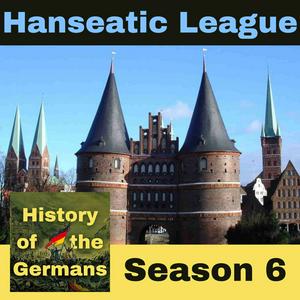
Though the Hanseatic League ended formally in 1669, this medieval associations of merchants still casts a spell. Many cities along the Baltic and North Sea -Lubeck, Hamburg, Bremen, Rostock, Wismar, Riga, Tallin, bergen to name a few are proud to call themselves Hanseatic. But what was it about this organisation (if it even was one) that had no permanent institutions, not even a register of members and started out at the far fringes of the global trading system that feels still so relevant. This podcast series tries to get to the bottom of this.
This podcast is part of the broader History of the Germans podcast that aims to track the history of the German people from the Early Middle Ages to Reunification in 1991. If you enjoy this show, check out any of the other seasons or follow the main show.
So far I have the following seasons:
The Ottonians (919 AD-1024 AD)
Salian Emperors and Investiture Controversy (1024 AD-1125 AD)
Fredrick Barbarossa and Early Hohenstaufen (1125-1190)
Frederick II Stupor Mundi (1190-1268)
Saxony and Eastward Expansion
The Hanseatic League
The Teutonic Knights
The Holy Roman Empire (1250 AD -1356 AD)
The Reformation before the Reformation (1356AD -1439 AD)
The Empire in the 15th Century
The Fall and Rise of the Habsburgs (1439AD -1519 AD)
Podcast-WebsiteHöre The Hanseatic League, Hörsaal - Deutschlandfunk Nova und viele andere Podcasts aus aller Welt mit der radio.at-App
Hol dir die kostenlose radio.at App
- Sender und Podcasts favorisieren
- Streamen via Wifi oder Bluetooth
- Unterstützt Carplay & Android Auto
- viele weitere App Funktionen
Hol dir die kostenlose radio.at App
- Sender und Podcasts favorisieren
- Streamen via Wifi oder Bluetooth
- Unterstützt Carplay & Android Auto
- viele weitere App Funktionen
The Hanseatic League
Code scannen,
App laden,
loshören.
App laden,
loshören.
The Hanseatic League: Zugehörige Podcasts
 Österreich